
Strategy Isn’t a Skill You Learn. It’s a Mindset You Develop.
There is a persistent myth in product management that strategy is something you do — a quarterly exercise, a planning document, a framework you apply when the roadmap needs updating. Under this view, strategic thinking is a tool you pick up when needed and put down when the work begins.
This is wrong. And it explains why so many product teams produce strategies that look coherent on paper and dissolve on contact with reality.
Strategic thinking is not a tool. It is a way of seeing — a set of habits, questions, and mental models that shape how you interpret information, frame problems, and make decisions. It is not something you switch on for the annual strategy offsite and switch off for the rest of the year. It is the operating system that runs underneath everything else.
The good news is that it can be developed. Strategic thinking is not a fixed trait distributed unevenly at birth. It is a skill — or more precisely, a cluster of skills — that responds to deliberate practice, the right frameworks, and consistent reflection. The product managers who think most strategically are not the ones who are naturally gifted; they are the ones who have built the habits that make strategic thinking automatic.
This article is about those habits, the questions that unlock them, and the exercises that build them over time.
The 5 Habits of Strategic Thinkers
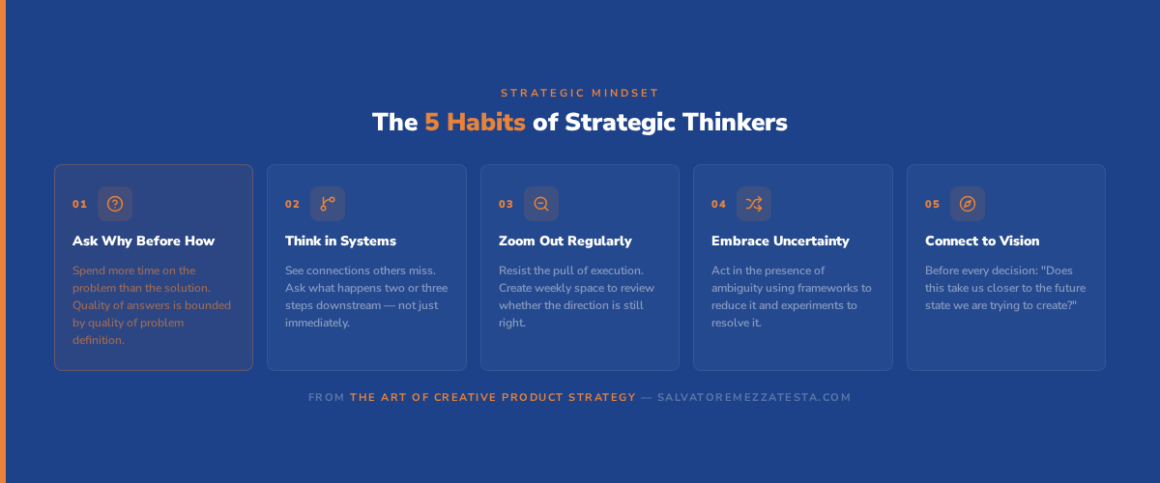
Strategic thinking is not a single skill — it is a cluster of habits that, practised together, produce a fundamentally different quality of decision-making. Here are the five habits that distinguish strategic thinkers from tactical ones.
Habit 1: Ask why before how. Tactical thinkers move quickly to solutions. Strategic thinkers spend more time on the problem. Before asking “how do we build this?” they ask “why does this matter?” and “what problem are we actually solving?” This habit — which Richard Rumelt calls “diagnosing before prescribing” in Good Strategy, Bad Strategy — is the single most important differentiator between strategic and tactical thinking. The quality of your solution is bounded by the quality of your problem definition.
Habit 2: Think in systems. Strategic thinkers see connections that tactical thinkers miss. They ask not just “what will happen if we do this?” but “what will happen two or three steps downstream?” They understand that products exist within ecosystems — of users, competitors, technologies, and incentives — and that decisions made in one part of the system create effects throughout it. Systems thinking, as articulated by Donella Meadows, is the discipline of understanding these feedback loops and second-order effects before they become surprises.
Habit 3: Zoom out regularly. The pressure of execution pulls attention toward the immediate — the sprint, the release, the customer complaint. Strategic thinkers resist this pull by deliberately creating space to zoom out: to look at the six-month and twelve-month horizon, to review whether the current work is moving the strategic metrics, to ask whether the direction is still right. This is not a quarterly exercise — it is a weekly discipline. Even fifteen minutes of strategic reflection per week, consistently applied, compounds into a significantly different quality of thinking over time.
Habit 4: Embrace uncertainty. Tactical thinking seeks certainty before acting. Strategic thinking acts in the presence of uncertainty, using frameworks to reduce it and experiments to resolve it. As Daniel Kahneman documents in Thinking, Fast and Slow, the human mind is wired to prefer the illusion of certainty over the discomfort of ambiguity. Strategic thinkers override this preference — not by pretending certainty exists, but by building decision frameworks that work well under uncertainty.
Habit 5: Connect decisions to vision. Every decision a product team makes is either moving toward the vision or away from it. Strategic thinkers make this connection explicit. Before committing to a direction, they ask: “Does this take us closer to the future state we are trying to create?” This habit — vision thinking applied to daily decisions — is what keeps strategy from being a document and makes it a living guide.
The Strategist’s Superpower: Asking Better Questions
If there is a single skill that separates strategic thinkers from everyone else, it is the quality of their questions. Strategic thinkers do not have better answers — they have better questions. And better questions, consistently applied, produce better answers over time.
The most powerful strategic questions share a common structure: they challenge assumptions, expand the frame of reference, and force consideration of second-order effects. Here are the questions that strategic thinkers ask most consistently.
“What are we assuming to be true?” Every strategy rests on a set of assumptions — about customer behaviour, market dynamics, competitive response, and technology trajectory. Most of these assumptions are never made explicit. Strategic thinkers surface them, because an unexamined assumption is a strategic risk. The first step in first principles thinking — the reasoning method associated with Elon Musk and Aristotle alike — is identifying and questioning the assumptions that everyone else takes for granted.
“What would have to be true for this to fail?” Pre-mortem thinking — imagining that a strategy has failed and working backwards to identify the cause — is one of the most reliable methods for identifying strategic blind spots. It forces consideration of the scenarios that optimism tends to exclude.
“Who are we not building for?” User-centric thinking is often interpreted as building for your current users. Strategic thinkers also ask who they are explicitly choosing not to serve — because every strategic choice is simultaneously an inclusion and an exclusion. Clarity about who you are not building for is as important as clarity about who you are.
“What does the second-order effect look like?” First-order effects are usually obvious. Second-order effects — the consequences of the consequences — are where strategy lives. A feature that increases engagement in the short term might reduce retention in the long term. A pricing change that increases revenue this quarter might damage trust over the following year. Strategic thinkers trace the chain of effects before committing to a direction.
Frameworks for Breaking Down Complex Problems
Strategic thinking is not purely intuitive — it is supported by frameworks that make complex problems tractable. Here are three that the most effective product strategists use consistently.
First Principles Thinking breaks a problem down to its fundamental components and reasons upward from there, rather than reasoning by analogy from existing solutions. It is most useful when the conventional approach is producing mediocre results and you need to find a genuinely different path. The question to ask is: “If we stripped away everything we assume to be true about this problem, what would we be left with?”
The Five Whys — originally developed by Toyota as a root cause analysis tool — is equally powerful as a strategic diagnostic. When a strategy is underperforming, asking “why?” five times in succession almost always surfaces the real cause rather than the proximate one. The first answer is usually a symptom; the fifth answer is usually a structural issue.
The Inversion Principle asks: “What would guarantee failure?” and then works to avoid those conditions. Charlie Munger, Warren Buffett’s long-time partner, described inversion as one of the most powerful thinking tools available: “Invert, always invert.” For product strategists, the question is not just “how do we succeed?” but “what would make us fail, and how do we prevent it?”
Exercises to Develop Your Strategic Mindset
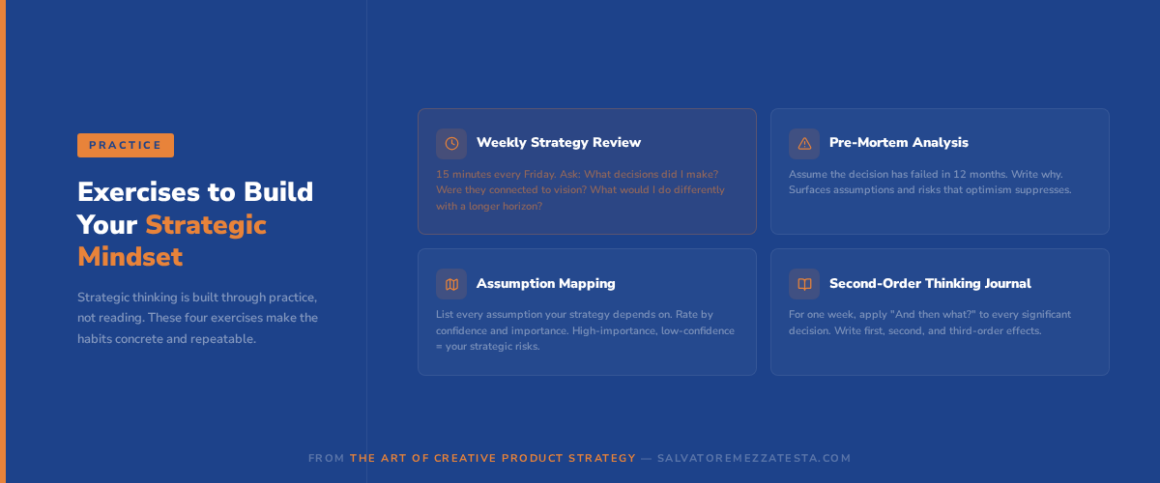
Reading about strategic thinking is useful. Practising it is what changes how you think. Here are four exercises that build strategic thinking as a muscle rather than a concept.
The Weekly Strategy Review (15 minutes, every Friday). Set aside fifteen minutes at the end of each week to ask three questions: What decisions did I make this week? Were they connected to the strategic vision? What would I do differently with a longer time horizon? This exercise builds the habit of connecting daily work to strategic direction — and over time, it makes that connection automatic rather than deliberate.
The Pre-Mortem. Before committing to any significant strategic decision, run a pre-mortem: assume the decision has failed spectacularly twelve months from now, and write a one-page account of why. This exercise surfaces the assumptions and risks that optimism tends to suppress, and it produces a risk register that makes the decision more robust. It takes thirty minutes and consistently improves the quality of strategic decisions.
Assumption Mapping. For any strategy or major initiative, list every assumption it depends on — about customer behaviour, market dynamics, competitive response, and technology. Then rate each assumption on two dimensions: how confident are you that it is true, and how important is it to the strategy’s success? The assumptions that are high-importance and low-confidence are your strategic risks. Address them first.
The Second-Order Thinking Journal. For one week, apply second-order thinking to every significant decision you encounter — at work and outside it. For each decision, ask: “And then what?” Write down the first-order effect, then the second-order effect, then the third. This exercise builds the habit of tracing consequences beyond the immediate, which is the core skill of strategic thinking.
Resources for Ongoing Learning
Good Strategy, Bad Strategy by Richard Rumelt remains the most rigorous and practical book on strategy available. Rumelt’s central argument — that most “strategy” is not strategy at all, but a collection of goals dressed up as a plan — is a corrective that every product leader needs. Thinking, Fast and Slow by Daniel Kahneman provides the cognitive science foundation for understanding why strategic thinking is hard and how to overcome the biases that undermine it.
For ongoing development, Reforge offers the most rigorous product strategy curriculum available outside of a business school. Their programmes on product strategy, growth, and retention are built around the same principles of systems thinking and outcome orientation that this article describes. Harvard Business Review publishes consistently excellent material on strategic thinking, decision-making, and leadership — and their archives are a reliable source of case studies and frameworks.
The most important resource, however, is practice. Creative thinking and strategic thinking reinforce each other — the more you practise both, the more fluent you become in moving between them. If you want to explore the strategic mindset module in depth — including guided exercises, case studies, and a self-assessment — that is exactly what The Art of Creative Product Strategy covers.
Key Takeaways
- Strategic thinking is a mindset, not a tool. It is not something you switch on for the annual planning cycle — it is the operating system that shapes how you see problems and make decisions every day.
- The five habits of strategic thinkers are: ask why before how, think in systems, zoom out regularly, embrace uncertainty, and connect decisions to vision.
- The strategist’s superpower is asking better questions. “What are we assuming to be true?” “What would have to be true for this to fail?” “What does the second-order effect look like?” These questions, consistently applied, produce better decisions.
- Three frameworks that make complex problems tractable: First Principles Thinking, the Five Whys, and the Inversion Principle.
- Strategic thinking is built through practice. The Weekly Strategy Review, Pre-Mortem, Assumption Mapping, and Second-Order Thinking Journal are four exercises that build the habit systematically.
Ready to Go Deeper?
Strategic thinking is the foundation of everything else in product leadership. Without it, frameworks are just templates, roadmaps are just lists, and strategy documents are just words. Get The Art of Creative Product Strategy on Amazon →
The book covers the complete strategic mindset framework — from the habits and questions that define strategic thinkers to the exercises and case studies that make those habits concrete.
Want to start with the fundamentals?
Download Module 1 free and begin building the strategic foundation that makes everything else possible. Download Module 1 Free →
Frequently Asked Questions About Strategic Thinking
Q1: Can strategic thinking be learned, or is it innate?
Strategic thinking can absolutely be learned. It is a skill — or more precisely, a cluster of habits — that develops with practice, exposure to frameworks, and deliberate reflection. Some people have natural inclinations toward systems thinking or long-horizon planning, but everyone can develop strategic thinking through consistent practice. The exercises in this article are designed precisely for that purpose.
Q2: What is the difference between strategic thinking and tactical thinking?
Tactical thinking focuses on how to execute today — the sprint, the release, the immediate problem. Strategic thinking focuses on where to go and why — the six-month and twelve-month horizon, the connection between daily decisions and long-term vision. Both are necessary, but they operate at different time horizons and levels of abstraction. The most effective product managers move fluidly between both modes.
Q3: How do I know if I am thinking strategically?
You are thinking strategically if you are asking “why” more than “how,” thinking about six to twelve months ahead rather than just the next sprint, connecting decisions to long-term vision, and considering second- and third-order effects. If your thinking is primarily focused on execution and immediate problems, you are thinking tactically — which is valuable, but not sufficient for strategic leadership.
Q4: What is the most important habit of strategic thinkers?
Asking better questions. Strategic thinkers do not jump to solutions — they spend more time understanding the problem deeply before proposing answers. The habit of asking “why does this matter?”, “what are we assuming to be true?”, and “what would have to be true for this to fail?” before moving to solutions is the single most impactful habit you can develop.
Q5: How do I develop strategic thinking if I am in a tactical role?
Volunteer for cross-functional projects that require you to think across the organisation. Read strategy books — Rumelt, Porter, Christensen. Talk to people in strategic roles and ask them how they frame problems. Reflect on your work regularly and ask “why are we doing this?” Apply the exercises in this article — particularly the Weekly Strategy Review and the Pre-Mortem — to your current work. Strategic thinking develops through intentional practice, not through job title.
Q6: Can I be a good product manager without strategic thinking?
You can execute well without strategic thinking, but you will not drive strategic impact. Good product managers execute reliably. Great product managers think strategically and execute. The difference is not incremental — it is the difference between building what is asked and building what matters. Strategic thinking is what allows you to push back on the wrong priorities and advocate for the right ones.
Q7: How do I balance strategic thinking with execution?
Dedicate time to both deliberately. A useful rule of thumb: spend 20% of your time thinking strategically — reading, reflecting, questioning assumptions, reviewing strategic metrics. Spend 80% executing. The 20% is not a luxury; it is the source of the direction that makes the 80% valuable. Without it, execution is efficient but not necessarily effective.
Q8: What is the relationship between strategic thinking and creativity?
Strategic thinking is the framework; creative thinking is the fuel. You need both. Strategic thinking without creativity produces competent but predictable strategies — the kind that every competitor can replicate. Creativity without strategic thinking produces interesting ideas that go nowhere. The most powerful product strategies are the ones where rigorous strategic thinking and genuine creative thinking reinforce each other.
Q9: How do I help my team develop strategic thinking?
Model it. Ask strategic questions in meetings — “why does this matter?”, “what are we assuming?”, “what is the second-order effect?” Encourage people to think about consequences beyond the immediate. Give people time to think, not just execute. Celebrate strategic insights — the question that reframed a problem, the assumption that was surfaced and tested — not just tactical wins. Strategic thinking is contagious when leaders demonstrate it consistently.
Q10: What resources should I use to develop strategic thinking?
Start with Good Strategy, Bad Strategy by Richard Rumelt and Thinking, Fast and Slow by Daniel Kahneman — they provide the conceptual foundation. Then apply the frameworks through practice: Reforge for structured product strategy development, Harvard Business Review for ongoing case studies and frameworks, and the exercises in this article for daily habit-building. The most important resource is consistent practice — reading without application produces knowledge, not capability.