If Your Strategy Isn’t Working, It’s Probably One of These 7 Reasons
Most product strategies fail quietly. There is no dramatic moment of collapse — no single decision that can be pointed to as the cause. Instead, there is a slow accumulation of misalignment, missed signals, and unmeasured drift, until one day the team is executing furiously on a direction that no longer makes sense, and nobody is quite sure when that happened.
The uncomfortable truth is that product strategy failure is rarely caused by a lack of intelligence or effort. It is caused by specific, identifiable structural problems that repeat across companies, industries, and market conditions. The same seven failure modes appear again and again, in startups and enterprises alike, in teams that are well-resourced and teams that are not.
This article names them. More importantly, it provides a diagnostic framework for identifying which failure mode is affecting your strategy, and a set of concrete interventions for each one.
If your strategy is not working, the answer is almost certainly in this list.
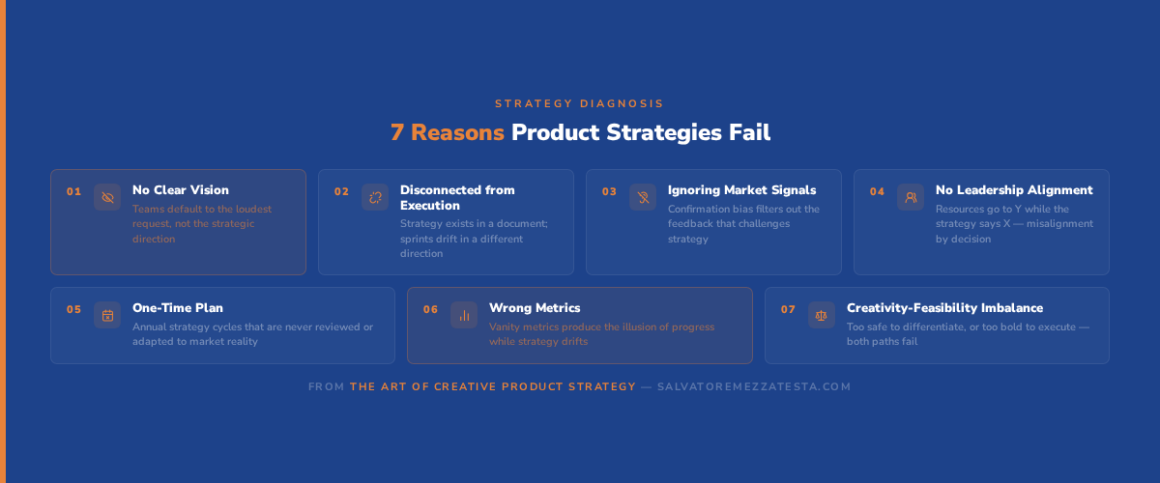
Reason 1: No Clear Vision, or a Misaligned One
A strategy without a clear vision is not a strategy, but just a list of activities. Vision is the foundation on which every strategic decision rests. It answers the question that strategy cannot answer for itself: where are we going, and why does it matter?
When vision is absent, teams default to building what is loudest — the feature request from the biggest customer, the capability that the competitor just shipped, the idea that the CEO mentioned in passing. Each individual decision may seem reasonable; collectively, they produce a product that is incoherent and a team that is confused about its own direction.
When vision is present but misaligned — when the product team’s vision contradicts the commercial team’s goals, or when the stated vision bears no relationship to the actual priorities — the damage is more insidious. Teams operate under the illusion of alignment while pulling in different directions. The strategy document says one thing; the roadmap does another; the budget allocates resources to a third.
The fix: Audit your vision against your actual decisions. For the last three months, look at what was built, what was prioritised, and what was deprioritised. Does it reflect the stated vision? If not, you have either a vision problem (the vision is wrong) or an alignment problem (the vision is right but not being used). Both are fixable, but they require different interventions.
Reason 2: Strategy Disconnected from Execution
A strategy that exists only in a document is not a strategy but a hypothesis. Strategy execution is where strategy either proves itself or fails. The most common form of this failure is not a dramatic departure from the strategy; it is a slow, incremental drift, as individual decisions, each of which seems reasonable in isolation, but collectively move the team away from the strategic direction.
This happens because execution operates at a different time horizon and level of abstraction than strategy. The sprint is about this week. The strategy is about the next twelve months. Without a deliberate mechanism for connecting the two, like a regular review process that asks “is what we are building this sprint moving us toward the strategic goals?”, the gap between strategy and execution widens silently.
The case of Quibi is instructive. The strategy was clear: short-form premium content for mobile consumption. The execution, however, was disconnected from the strategic insight that mobile viewers consume content in fragmented moments — on commutes, in queues, in the margins of the day. Quibi launched in April 2020, two weeks into a global pandemic that eliminated commuting and fragmented moments. The strategy was not wrong; the execution was not connected to the market reality that strategy depended on.
The fix: Build a weekly cadence that explicitly connects sprint decisions to strategic goals. Every sprint planning session should include the question: “Which strategic objective does each of these items advance?” If the answer is “none,” the item should not be in the sprint.
Reason 3: Ignoring User Feedback and Market Signals
Strategies are built on assumptions about users and markets. Those assumptions have a shelf life. Markets shift, user needs evolve, and competitors change the landscape. A strategy that was correct eighteen months ago may be wrong today — not because it was poorly conceived, but because the world it was designed for no longer exists.
The failure mode here is not a lack of user feedback, because most teams collect plenty of it, but the failure in the interpretation. Teams tend to hear the feedback that confirms the existing strategy and discount the feedback that challenges it. This is not dishonesty; it is a well-documented cognitive bias that Daniel Kahneman calls “confirmation bias” — the tendency to seek and weight evidence that supports existing beliefs.
Amazon’s Fire Phone is the canonical example. Amazon had extensive user research, but it was interpreted through the lens of what Amazon wanted to build — a premium smartphone that would lock users into the Amazon ecosystem. The market signal that users did not want another premium smartphone, and that the Amazon ecosystem was not a sufficient differentiator, was available but not heard.
The fix: Create a formal process for surfacing and discussing market signals that challenge the current strategy. Designate a “devil’s advocate” role in strategy reviews whose explicit job is to argue against the current direction using market evidence. Make it structurally safe to say “our strategy might be wrong.”
Reason 4: Lack of Leadership Alignment
A strategy that is not supported by leadership is not a strategy but is a wish. Leadership alignment is not about getting everyone to agree on every decision; it is about ensuring that the people who control resources, priorities, and organisational direction are pulling in the same direction.
The most common form of this failure is not overt disagreement but passive misalignment. The leadership team nominally endorses the strategy but continues to make resource allocation decisions, hiring decisions, and priority calls that are inconsistent with it. The strategy says “we are investing in enterprise”; the sales team is still incentivised on SMB revenue. The strategy says “we are building for long-term retention”; the marketing team is still measured on new user acquisition. These misalignments are not accidents — they are the residue of a strategy that was adopted at the level of words but not at the level of decisions.
The fix: Audit resource allocation against strategic priorities. If the strategy says X is the priority but the budget, headcount, and executive attention are going to Y, the strategy is Y, regardless of what the document says. Alignment is revealed by decisions, not declarations.
Reason 5: Treating Strategy as a One-Time Plan
Strategy is not a document but a practice. The most common strategic planning mistake is treating the annual strategy cycle as the strategy itself, rather than as a checkpoint in an ongoing process of learning and adaptation.
Markets do not pause for annual planning cycles. User needs do not wait for the next strategy offsite. Competitors do not schedule their moves around your review calendar. A strategy that is reviewed once a year and executed unchanged for twelve months is not a strategy but a plan that is becoming progressively more disconnected from reality with each passing month.
Reforge describes this as the difference between “strategy as a document” and “strategy as a practice.” The former is an artefact; the latter is a discipline. Companies that treat strategy as a practice by reviewing it quarterly, updating it when market signals warrant, and connecting it explicitly to execution decisions, consistently outperform those that treat it as an annual exercise.
The fix: Establish a quarterly strategy review cadence. Not a full strategy rewrite, but a structured review of three questions:
- What has changed in the market since last quarter?
- Are our strategic assumptions still valid?
- What, if anything, needs to change in our direction?
Reason 6: Measuring the Wrong Metrics
You cannot manage what you do not measure, but you can easily mismanage what you measure incorrectly. Measuring the wrong strategic metrics is one of the most common and most expensive forms of strategy failure, because it produces the illusion of progress while the strategy is actually drifting.
The most common version of this failure is the vanity metric trap: measuring total registered users instead of active users, measuring features shipped instead of outcomes achieved, measuring page views instead of meaningful engagement. These metrics look good in dashboards and board presentations; they tell you almost nothing about whether the strategy is working.
Google Glass is the clearest example. By the metrics that were being measured — media coverage, developer interest, units shipped to early adopters — the product appeared to be succeeding. By the metrics that actually mattered — mainstream consumer adoption, use cases that justified the price point, user retention — it was failing. The strategy was not revised because the metrics being watched did not reveal the failure until it was too late.
The fix: For each strategic goal, define one leading indicator (a metric that predicts future success) and one lagging indicator (a metric that confirms past success). Measure both. If the leading indicator is moving in the wrong direction, act before the lagging indicator confirms the failure.
Reason 7: Not Balancing Creativity with Feasibility
The final failure mode is the one that is hardest to diagnose, because it manifests in two opposite directions. Some strategies fail because they are too conservative and optimise for what is known and feasible, and produce strategies that are competent but undifferentiated. Other strategies fail because they are too creative and pursue bold ideas without sufficient grounding in what is buildable, commercially viable, or strategically coherent.
Both failure modes share a common root: the absence of a deliberate framework for evaluating creative ideas against strategic and feasibility criteria. Without such a framework, teams either default to the safe and familiar (because it is easier to justify) or pursue the exciting and novel (because it is more energising), without a principled basis for the choice.
The fix: Apply a three-filter test to every significant strategic initiative:
- Does it align with the vision?
- Is it grounded in genuine user insight?
- Is there a credible feasibility pathway?
An initiative that passes all three filters is a strategic bet worth taking. An initiative that fails one or more is either a risk to be managed or an idea to be parked.
Diagnostic Checklist: Where Is Your Strategy Failing?
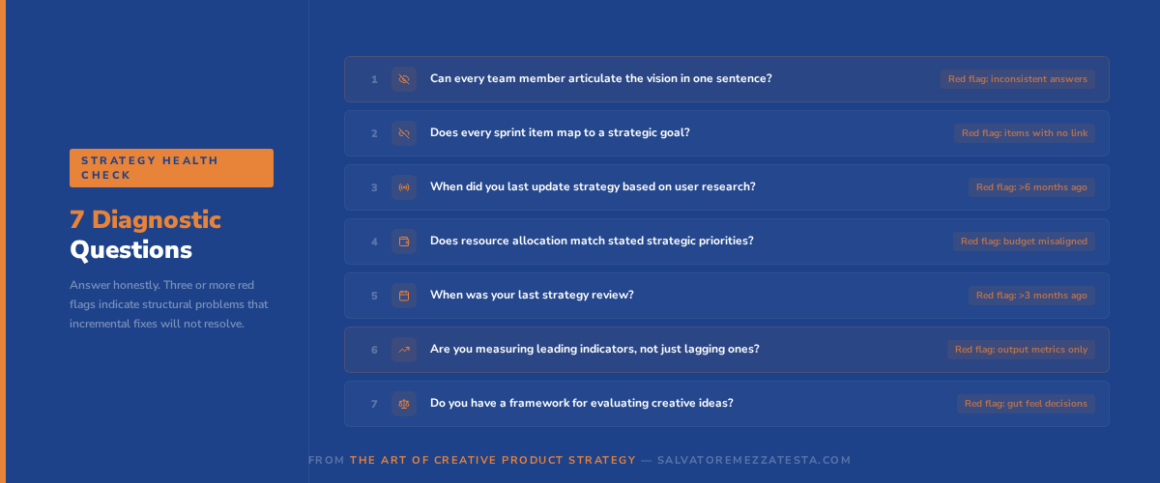
Use this checklist to identify which failure mode is most affecting your current strategy. For each item, answer honestly: is this a strength, a weakness, or a gap?
| Failure Mode | Diagnostic Question | Red Flag |
|---|---|---|
| Vision | Can every team member articulate the vision in one sentence? | Inconsistent answers across the team |
| Execution connection | Does every sprint item map to a strategic goal? | Items that cannot be connected to strategy |
| Market signals | When did you last update your strategy based on user research? | More than 6 months ago |
| Leadership alignment | Does resource allocation match stated strategic priorities? | Budget and headcount going to non-priority areas |
| Strategy as practice | When was your last strategy review? | More than 3 months ago |
| Metrics | Are you measuring leading indicators, not just lagging ones? | Only tracking output metrics |
| Creativity-feasibility | Do you have a framework for evaluating creative ideas? | Decisions made on gut feel or seniority |
If you identified three or more red flags, your strategy has structural problems that incremental fixes will not resolve. The full Strategy Framework is covered in The Art of Creative Product Strategy.
Key Takeaways
- Product strategy failure is structural, not accidental. The same seven failure modes appear repeatedly across companies and industries. Identifying which one is affecting your strategy is the first step to fixing it.
- Vision is the foundation. A strategy without a clear, aligned vision is a list of activities. Audit your actual decisions against your stated vision — the gap between them reveals the real problem.
- Strategy and execution must be explicitly connected. Without a weekly cadence that connects sprint decisions to strategic goals, the gap between strategy and execution widens silently.
- Measure leading indicators, not just lagging ones. Vanity metrics produce the illusion of progress while the strategy drifts. Define one leading and one lagging indicator for each strategic goal.
- Strategy is a practice, not a document. Quarterly reviews, market signal integration, and a willingness to adapt are what separate strategies that work from strategies that age.
Ready to Diagnose and Fix Your Strategy?
The seven failure modes in this article are the starting point. The full Strategy Framework with detailed case studies, and practical exercises is in The Art of Creative Product Strategy.
Get The Art of Creative Product Strategy on Amazon →
Want to start with the fundamentals?
If you are not sure whether your strategy is failing or just slow, start with the foundation. Download Module 1 free and build the strategic clarity that makes diagnosis possible.
Frequently Asked Questions About Product Strategy Failure
Q1: How do we know if our strategy is failing?
The clearest signs are: you are not hitting strategic KPIs after six to twelve months of execution; your market position is weakening relative to competitors; your team cannot articulate the strategic direction clearly; and you are constantly reacting to competitors rather than setting the agenda. Any one of these signals warrants a strategy review. Multiple signals together indicate a structural problem that requires intervention.
Q2: Is strategy failure always the product’s fault?
No. Strategy failure has multiple root causes — some internal, some external. Sometimes the market changes faster than the strategy can adapt. Sometimes execution is poor but the strategy is sound. Sometimes leadership does not support the strategy with the resources it requires. Before diagnosing the strategy itself, diagnose the system: is the failure in the strategy, the execution, the alignment, or the market context?
Q3: Can we fix a failing strategy mid-course?
Yes, but it is disruptive and requires honest acknowledgement of what is not working. If the strategy is fundamentally wrong, e.g. the vision is misaligned, the market assumption is incorrect, then it needs to be changed, not optimised. If the execution is wrong but the strategy is sound, fix the execution. If the market has changed, adapt the strategy to the new reality. The one thing that does not work is changing strategy every quarter in response to short-term pressure — that is not adaptation, it is instability.
Q4: What is the difference between a failing strategy and a strategy that is just slow to show results?
A failing strategy shows no progress toward strategic KPIs after six to twelve months of consistent execution. A slow strategy shows progress because leading indicators are moving in the right direction, but the pace is slower than anticipated. The distinction matters because the interventions are different: a failing strategy needs diagnosis and change; a slow strategy needs patience and possibly resource acceleration. Measuring leading indicators is what makes this distinction visible before the lagging indicators confirm it.
Q5: How do we get buy-in for strategy changes if the current strategy is failing?
Be honest about the failure. Show the data — the KPIs that are not moving, the market signals that were missed, the assumptions that turned out to be wrong. Explain what was learned. Present a revised strategy that is grounded in those learnings. People respect honesty and learning; they resent denial and spin. The teams that navigate strategy failure most successfully are the ones that treat it as a learning event rather than a political problem.
Q6: Should we involve the team in diagnosing strategy failure?
Absolutely. The team sees problems that leadership misses because they are closer to the user, closer to the execution, and often the first to notice when the strategy is not working. Create psychological safety for people to say “our strategy is not working” without fear of career consequences. Then diagnose together. The quality of the diagnosis improves significantly when it includes multiple perspectives.
Q7: How do we prevent strategy failure?
Prevention is more effective than diagnosis. The key practices are: start with a clear, aligned vision; ensure leadership alignment is reflected in resource allocation, not just declarations; communicate strategy relentlessly so the team can connect daily decisions to strategic direction; measure leading indicators so problems are visible before they become failures; review strategy quarterly; and build a culture where market signals that challenge the strategy are welcomed rather than suppressed.
Q8: What is the cost of strategy failure?
The direct costs are wasted resources — the engineering time, design effort, and commercial investment that went into executing a strategy that was not working. The indirect costs are often larger: missed market opportunities that competitors captured, team confusion and low morale, and the organisational credibility loss that makes the next strategy harder to execute. In the most severe cases, strategy failure is an existential threat. The cost of getting strategy right is always lower than the cost of getting it wrong.
Q9: Can a company recover from strategy failure?
Yes — if leadership acknowledges the failure, learns from it, and implements a better strategy quickly. The companies that recover are the ones that treat strategy failure as diagnostic information rather than as a verdict. Companies that fail to recover are typically the ones that double down on failing strategies in the hope that more execution will fix a strategic problem, or that change strategy so frequently that the organisation loses confidence in any direction at all.
Q10: How do we build organisational resilience to strategy failure?
Resilience comes from learning, not from being right. Build feedback loops that surface issues early — regular strategy reviews, market signal integration, and a culture where people can speak up about problems without fear. Create a shared language for strategy so that everyone in the organisation can participate in the diagnosis. And build the habit of treating strategy as a practice rather than a document — something that is reviewed, updated, and connected to execution on a continuous basis.