Creative product strategy is not about making things look beautiful. It is not about running brainstorming sessions with sticky notes on a whiteboard. And it is certainly not about giving your team “creative freedom” and hoping something interesting emerges.
It is about making bold, deliberate choices about what problem you solve, who you solve it for, and why your solution is meaningfully different from everything else in the market. That kind of thinking is rare. And its absence is why so many smart, well-resourced product teams end up shipping products that are technically competent but strategically forgettable.
This article is about why that happens — and what to do about it.
Why Creative Product Strategy Is the Hardest Strategic Skill
Here is a pattern I have seen play out more times than I can count.
A talented team gets together to define a new product direction. They do the research. They run the workshops. They map the user journeys. They look at the competitive landscape. And then, after all that work, they produce a roadmap that looks almost identical to what their competitors are already building.
Not because they are not smart. Not because they did not try. But because the process they used — the very process designed to generate good ideas — was optimised for safety, not for creative insight.
Research from McKinsey consistently shows that companies which outperform their peers on innovation are not necessarily the ones with the biggest R&D budgets or the most talented engineers. They are the ones that have built a culture and a process for making creative strategic choices that are bold enough to differentiate, but grounded enough to execute.
Creative product strategy is the discipline that bridges those two things. It is the hardest strategic skill because it requires you to hold two contradictory impulses in tension at the same time: the courage to think differently, and the rigour to make that thinking actionable.
The Real Reason Teams Default to Safe, Incremental Thinking
Before we talk about how to be more creative, it is worth being honest about why most teams are not.
The answer is not a lack of imagination. It is a lack of permission.
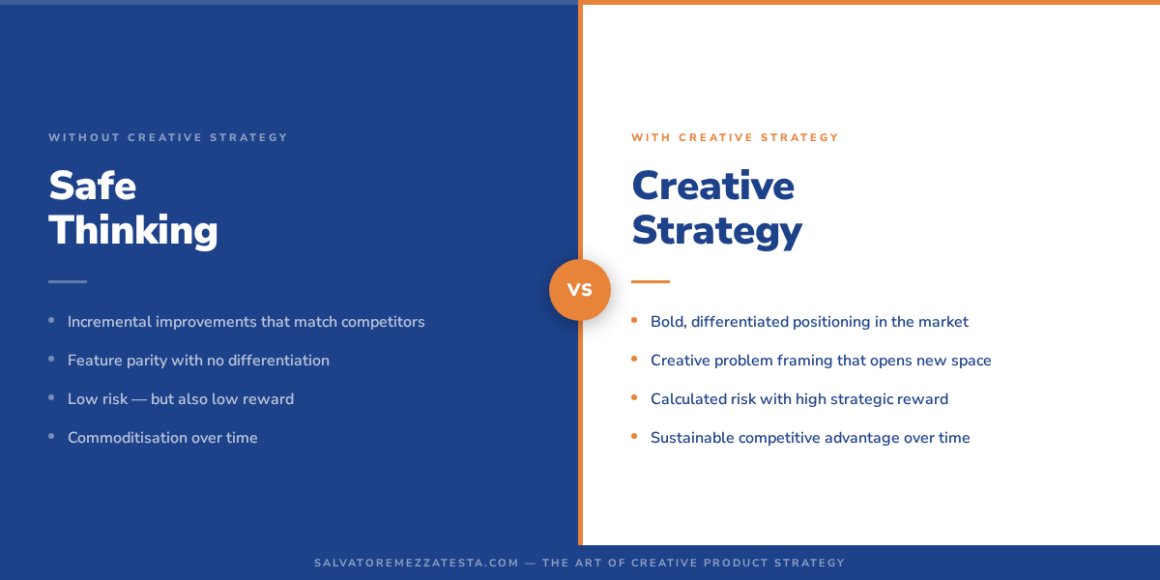
Most product teams operate inside organisations where the incentive structure quietly punishes creative risk. A feature that ships on time and hits its OKRs is celebrated. A bold strategic bet that takes six months to validate and then pivots is treated as a failure — even if the learning was invaluable. Over time, teams learn to optimise for the metrics that get them recognised, not the thinking that would actually move the needle.
There is also a cognitive dimension to this. When we are under pressure — tight deadlines, competing priorities, stakeholder demands — our brains default to what psychologists call “convergent thinking”: the rapid narrowing of options toward a single, safe solution. Divergent thinking — the kind that generates genuinely novel ideas — requires time, psychological safety, and a tolerance for ambiguity that most product environments do not naturally provide.
The result is what I call the creativity crisis in product strategy: a widespread pattern where smart, capable teams consistently under-deliver on the creative potential of their products — not because they cannot think creatively, but because their environment does not make space for it.
Creative Strategy vs. Creative Design: Understanding the Difference
One of the most common confusions I encounter is between creative product strategy and creative product design.
They are not the same thing. And conflating them is one of the reasons so many products end up beautifully designed but strategically undifferentiated.
Design creativity is about how something looks, feels, and functions. It is the craft of making a product delightful to use. Strategic creativity is about what problem you choose to solve, who you choose to solve it for, and why your approach is meaningfully better than the alternatives. A product can be visually stunning and strategically boring. And a product can look unremarkable and be strategically brilliant.
Consider Slack. When it launched, it was not the most visually impressive tool in the market. What made it strategically creative was the framing: instead of positioning itself as “a better email” or “a team chat tool,” Slack positioned itself as a way to make your working life simpler, more pleasant, and more productive — a promise that resonated deeply with people who were drowning in email threads and disconnected tools. That positioning was a creative strategic choice, not a design choice. And it is what drove the company from zero to a $27 billion acquisition in under a decade.
This is the kind of creativity that creative product strategy is concerned with. Not aesthetics, but positioning. Not features, but problem framing. Not polish, but differentiation.
The Creativity-Feasibility Spectrum
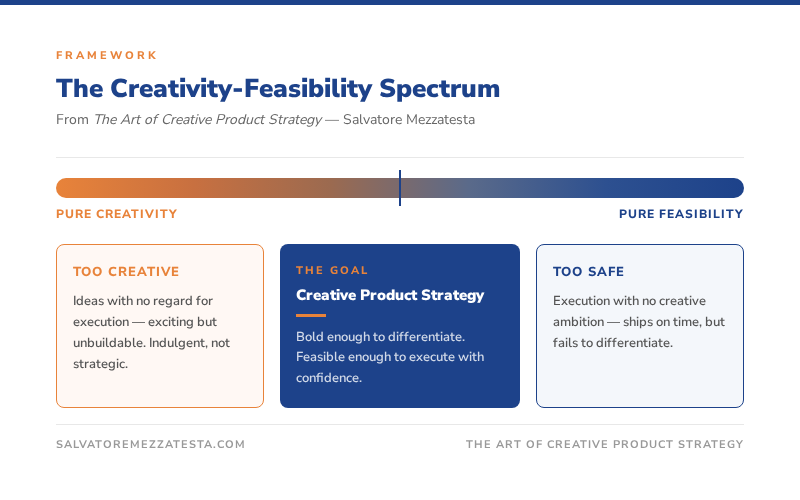
One of the frameworks I introduce in The Art of Creative Product Strategy is what I call the creativity-feasibility spectrum — a way of thinking about the relationship between bold creative ideas and practical execution constraints.
The spectrum runs from pure creativity (ideas with no regard for feasibility) at one end, to pure feasibility (execution with no creative ambition) at the other. Neither extreme produces great products.
Pure creativity without feasibility is indulgent. You generate exciting ideas that your team cannot build, your market does not understand, or your business cannot sustain. Pure feasibility without creativity is commoditising. You ship things that work but do not differentiate, and over time you become a feature factory competing on price.
The goal of creative product strategy is to find the productive middle ground: ideas that are creative enough to differentiate, and feasible enough to execute with confidence. This requires a specific kind of strategic thinking — one that starts with a bold creative hypothesis (“What if we solved this problem in a completely different way?”) and then stress-tests it against real constraints (“Can we build this? Will the market value it? Does it align with our vision?”).
If you want to explore this framework in depth, including the exercises I use with product teams to move from safe thinking to creative strategy, you can get the full book on Amazon, where I walk through it step by step.
Case Study: How Airbnb Used Creative Strategy to Reframe an Entire Market
When Airbnb launched, the conventional wisdom in the travel industry was clear: people want consistency, reliability, and brand trust when they travel. That is why hotel chains spent decades building standardised experiences — same room layout, same amenities, same breakfast buffet in every city.
Airbnb’s creative strategic insight was to question that assumption entirely. What if a significant segment of travellers did not want consistency? What if they wanted belonging, the feeling of living like a local, staying in a real home, connecting with real people?
That reframing was not a design decision. It was a strategic one. And it unlocked a market that the hotel industry had not seen because it was too busy optimising within its existing assumptions.
The lesson for product teams is this: the most powerful creative strategic moves often come not from generating new ideas, but from questioning the assumptions that everyone in your market takes for granted. What does your industry assume about what users want? What if that assumption is wrong, or only partially right?
This kind of thinking is what I mean when I talk about strategic creativity in the context of building a strategic mindset. It is not about being contrarian for its own sake. It is about being rigorous enough to challenge the conventional wisdom, and creative enough to see what others have missed.
How to Unlock Creative Thinking in Your Product Team
If you recognise the creativity crisis in your own team, here is where to start.
Start with the right question. Most product discovery processes start with “What should we build next?” That question anchors you in the present and leads to incremental answers. A more creative starting question is: “What would we build if we were starting from scratch today, knowing everything we know about our users and the market?” That reframe opens up strategic space that the first question closes off.
Create separation between divergence and convergence. One of the most common creativity killers in product teams is evaluating ideas at the same time as generating them. When people know their ideas will be immediately critiqued, they self-censor. Build explicit divergence phases into your process — time where the only rule is quantity, not quality. Then, separately, apply rigour to evaluate and prioritise.
Bring in user insights as a creative stimulus. The most powerful source of creative strategic ideas is not internal brainstorming but deep, qualitative user research. When you understand what users are really struggling with, what workarounds they have invented, and what they wish existed, you have raw material for genuinely creative strategic thinking. User insights do not just validate ideas; they generate them.
Protect creative thinking from premature closure. In most organisations, there is enormous pressure to converge quickly and get to a decision, a roadmap, a plan. Creative strategy requires resisting that pressure long enough to genuinely explore the space of possibilities. This is a leadership challenge as much as a process challenge. If you want to go deeper on how to build the strategic thinking skills that make this possible, that is exactly what I cover in the book.
The Strategic Cost of Playing It Safe
I want to end with something that I think is underappreciated in most conversations about product strategy.
Playing it safe is not actually safe.
When you make incremental, conservative strategic choices, you are not avoiding risk — you are accepting a different kind of risk. The risk of commoditisation. The risk of being outflanked by a competitor who was willing to make the bold move you were not. The risk of building a product that works perfectly and matters to no one.
The history of technology is littered with companies that were technically excellent and strategically timid. They built good products. They executed well. And then a competitor came along with a creative strategic insight that made everything they had built feel irrelevant.
Creative product strategy is not a nice-to-have. It is the discipline that determines whether your product has a future worth building toward.
If you want to develop that discipline to build the frameworks, the habits, and the creative strategic thinking that separates great products from forgettable ones — The Art of Creative Product Strategy is where you can start from.
Key Takeaways
- Creative product strategy is about bold, differentiated strategic choices — not aesthetics or brainstorming sessions.
- Most teams default to safe, incremental thinking because their environment punishes creative risk, not because they lack imagination.
- The distinction between creative design and creative strategy is critical: strategy comes first.
- The creativity-feasibility spectrum is the framework for finding the productive middle ground between bold ideas and practical execution.
- The most powerful creative strategic moves come from questioning the assumptions everyone in your market takes for granted.
- Playing it safe is not actually safe — it is accepting the risk of commoditisation and irrelevance.
Frequently Asked Questions About Creative Product Strategy
Q: Is creative product strategy the same as innovation?
Creative product strategy and innovation are closely related but distinct. Creativity is the ability to generate new ideas; innovation is turning those ideas into value. Creative product strategy is the discipline of making bold, differentiated strategic choices — it is the foundation that makes meaningful innovation possible. You can be creative without being innovative, and innovative without being particularly creative. Great product strategy requires both.
Q: Can creativity be taught, or is it an innate talent?
Creativity can absolutely be developed. It is not a talent you are born with — it is a skill you practise. The best creative strategic thinkers have learned frameworks, exposed themselves to diverse ideas, and practised divergent thinking regularly. The exercises in The Art of Creative Product Strategy are specifically designed to build this skill systematically, not just inspire it.
Q: How do we balance creativity with business constraints?
This is the core tension in product strategy, and it is what the creativity-feasibility spectrum is designed to address. Start by defining your constraints clearly (budget, timeline, technical feasibility, market readiness). Then ask: “What is the most creative solution within these constraints?” Creativity is not about ignoring constraints — it is about working brilliantly within them.
Q: Why do smart, experienced teams still default to safe thinking?
Because the incentive structure of most organisations quietly rewards safety. A feature that ships on time and hits its OKRs is celebrated. A bold strategic bet that takes time to validate is treated as a failure, even if the learning was invaluable. Over time, teams optimise for the metrics that get them recognised, not the thinking that would actually move the needle.
Q: What is the difference between creative product strategy and design creativity?
Design creativity is about how something looks, feels, and functions. Strategic creativity is about what problem you choose to solve, who you solve it for, and why your approach is meaningfully different. A beautifully designed product can still be strategically boring. Strategic creativity comes first — it is the foundation on which great design is built.
Q: How do we measure the ROI of creative strategy?
You measure it the same way you measure any strategy — through KPIs aligned with your vision. If your creative strategy is to differentiate in the market, measure market share and brand perception over time. If it is to improve retention through a differentiated experience, measure retention rates. The key is defining your strategic KPIs before you launch, not after.
Q: What kills creativity in product teams?
Fear of failure, unclear vision, too many constraints applied too early, lack of psychological safety, and leadership that punishes risk-taking. Creative strategic thinking requires explicit permission to explore, fail, and iterate. Without that permission, even the most creative people will self-censor.
Q: Can we be creative under tight deadlines?
Yes, but differently. With tight timelines, creativity becomes about prioritisation and focus — finding the one creative insight that matters most, rather than exploring the full space of possibilities. Long timelines allow for exploration; short timelines require decisiveness. Both are valid modes of creative strategy.
Q: How do we foster creative strategic thinking across the whole organisation, not just the product team?
Creativity is a cultural value, not a department. It starts with leadership modelling creative thinking, celebrating creative failures, and rewarding teams that take smart risks. It requires psychological safety, clear strategic direction, and explicit processes that separate divergent thinking from convergent evaluation.
Q: Is there such a thing as “too creative” in product strategy?
Yes. If your strategy is so creative that your team cannot execute it or your market cannot understand it, it is not strategic — it is indulgent. The best creative strategies are bold but comprehensible, ambitious but executable. The creativity-feasibility spectrum exists precisely to help teams find that balance.
Get the Full Framework
This article covers the foundations of creative product strategy. The complete framework — including the creativity-feasibility spectrum, the exercises I use with product teams, and the case studies that bring it to life — is in The Art of Creative Product Strategy.
Not ready to commit to the full book yet? Download Module 1 free — the foundational chapter on product strategy, available at no cost.