
There is a particular kind of product team that is always busy and never strategic. They read the same industry newsletters, attend the same conferences, and react to the same headlines. When AI becomes the dominant conversation, they add an AI feature. When no-code tools surge, they build a no-code layer. When a competitor ships something new, they ship something similar.
They call this “staying ahead of the market.” It is not. It is the absence of strategy dressed up as responsiveness.
Chasing trends is a strategy for mediocrity — because if you build what everyone else is building, you will end up where everyone else ends up: in a crowded market, competing on price, with no clear reason for customers to choose you over alternatives.
The question is not “which trends should we follow?” The question is “which trends are relevant to our strategy, our customers, and our vision?” That distinction — between trend-chasing and strategic adaptation — is what separates products that lead markets from products that follow them.
In this article, I will show you how to identify the trends that matter, evaluate them against your strategic direction, and adapt without losing the vision consistency that makes your product coherent.
Signal vs. Noise: How to Identify Trends That Matter
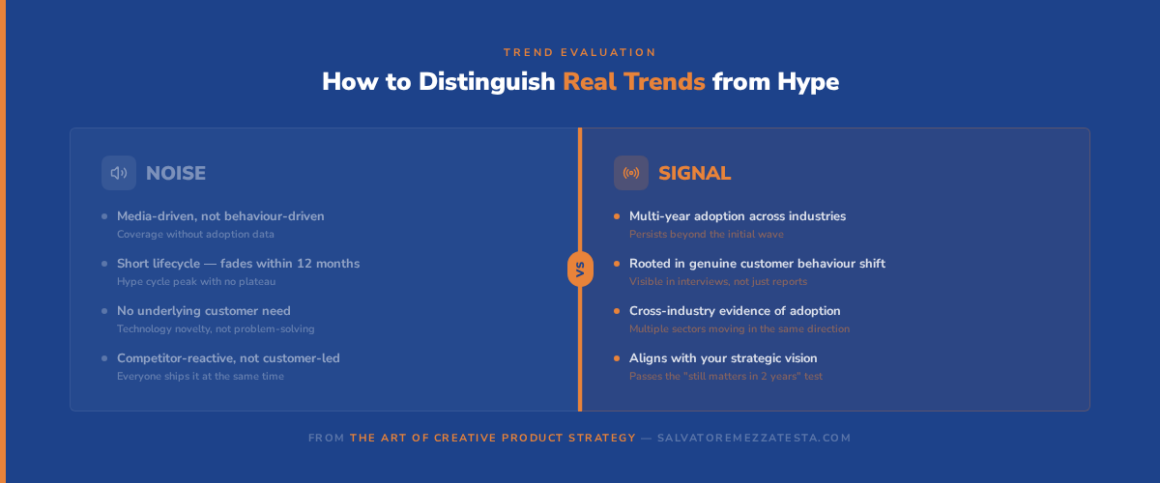
Not all trends are created equal. The product teams that navigate market change well are not the ones who spot trends earliest — they are the ones who distinguish between signal and noise most accurately.
A signal is a trend with staying power. It is driven by a genuine shift in customer behaviour, technology capability, or market structure. It persists across multiple years, appears in multiple industries, and reflects an underlying need that is not going away. The shift from desktop to mobile was a signal. The rise of remote work as a permanent mode of employment is a signal. The adoption of AI-assisted workflows across knowledge work is a signal.
Noise is a trend driven by media attention, competitive anxiety, or investor enthusiasm rather than customer need. It generates enormous coverage, inspires a wave of copycat products, and then fades — leaving teams that chased it with features that no one uses and roadmaps that no longer make sense.
The practical test is simple: ask “Will this still matter in two years?” If the answer is yes, and you can point to evidence of adoption across multiple companies and customer segments, you are looking at a signal. If the answer is uncertain, and the primary evidence is media coverage and competitor announcements, you are looking at noise.
Gartner’s Hype Cycle methodology provides a useful framework here: most technologies follow a predictable pattern from inflated expectations through disillusionment to a plateau of productive use. Understanding where a trend sits on that curve tells you whether you are early, on time, or late — and whether the trend is approaching maturity or still speculative.
A Framework for Evaluating Market Trends Strategically
Identifying a trend is only the first step. The more important question is whether that trend is relevant to your strategy. Here is a four-question framework for evaluating any market trend before deciding how to respond.
Question 1: Does this trend align with our vision?
Your vision is your filter. If a trend moves you toward the future state you are trying to create, it is worth investigating. If it pulls you in a different direction, it is a distraction — however large it may be. Vision consistency is not rigidity; it is the discipline that prevents your product from becoming a collection of reactions to external pressure.
Question 2: Does this trend reflect a real shift in customer need?
Trends that are driven by genuine customer need tend to be durable. Trends that are driven by technology novelty or competitive pressure tend to be fragile. Before responding to any trend, go back to your customers. Are they experiencing this shift? Are they asking for solutions in this space? If the trend is real in your market, you will see evidence in customer conversations, not just in industry reports.
Question 3: Does this trend represent an opportunity or a threat?
Some trends create new opportunities — new customer segments, new use cases, new distribution channels. Others represent threats — disruptive technologies that could make your product obsolete, new entrants that could undercut your positioning. The strategic response to an opportunity is different from the strategic response to a threat. Conflating the two leads to poor decisions.
Question 4: What is the cost of acting vs. the cost of waiting?
Not every trend requires an immediate response. Some trends reward early movers; others reward fast followers who let early movers absorb the risk. Evaluate the cost of acting now against the cost of waiting six to twelve months. If the cost of waiting is low and the uncertainty is high, wait and learn. If the cost of waiting is high and the evidence is strong, act.
| Trend Type | Strategic Response |
|---|---|
| Aligns with vision + strong customer signal | Investigate and integrate into roadmap |
| Aligns with vision + weak customer signal | Monitor closely; run small experiments |
| Does not align with vision + strong signal | Revisit strategy; is the vision still right? |
| Does not align with vision + weak signal | Ignore; document for quarterly review |
Case Study: How Figma Adapted Without Losing Direction
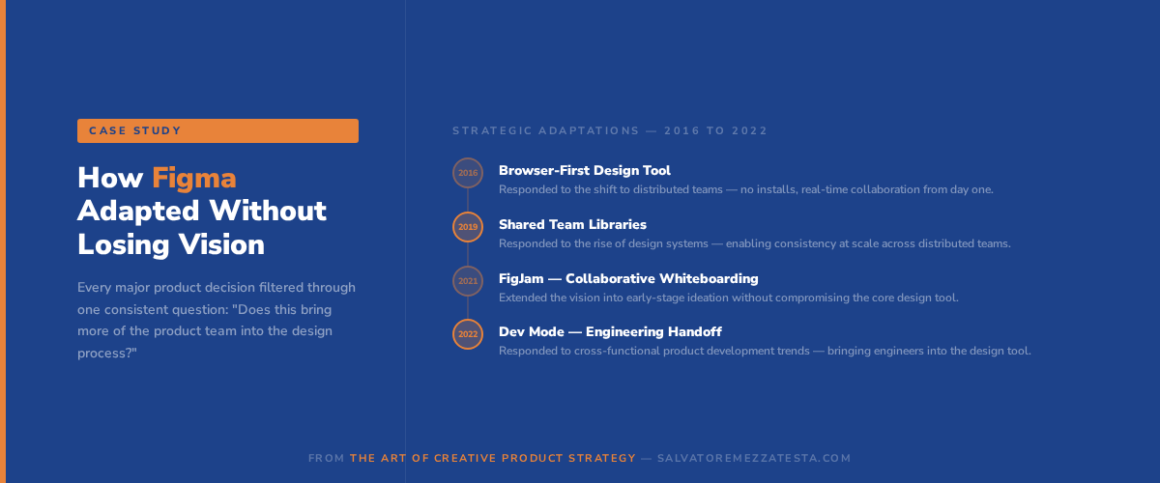
Figma’s history is one of the clearest examples of strategic adaptation done well. The company entered a market dominated by Adobe and Sketch with a clear and differentiated vision: design should be collaborative, browser-based, and accessible to the entire product team — not just designers.
That vision was their anchor. Every major product decision Figma made over the following years was an adaptation to market trends — but each adaptation was filtered through that core vision.
When the shift to remote and distributed teams accelerated (particularly post-2020), Figma did not simply add video calls or project management features. They deepened the collaborative capabilities that were already central to their vision: real-time multiplayer editing, shared component libraries, and branching workflows that let distributed teams work in parallel without conflict.
When the trend toward cross-functional product development strengthened — with engineers, product managers, and designers increasingly working in the same tools — Figma launched Dev Mode, a feature that made design handoff seamless for engineering teams. This was a response to a market trend, but it was a response that reinforced Figma’s positioning rather than diluting it.
When the demand for collaborative whiteboarding and early-stage ideation tools grew, Figma launched FigJam — a separate product that extended their vision into a new use case without compromising the core design tool.
As Figma’s own product blog has documented, each of these decisions was driven by a consistent question: “Does this bring more of the product team into the design process?” That question — derived directly from their vision — was the filter that kept Figma strategically coherent even as they adapted aggressively to market trends.
The lesson is not that Figma was lucky. It is that they had a vision clear enough to use as a filter, and the discipline to apply it consistently. Roadmap adaptation without a strategic anchor is just reaction. With one, it becomes evolution.
The Balance: Consistency vs. Adaptation
The hardest part of managing market trends is not identifying them. It is knowing when to hold your position and when to move.
The companies that get disrupted are not the ones that ignore trends entirely — they are the ones that ignore the trends that matter while chasing the ones that do not. Kodak did not fail because they ignored digital photography. They failed because they saw it, understood it, and chose not to adapt because adaptation threatened their existing business model. The trend was real. The strategic response was wrong.
Conversely, the companies that lose their identity are not the ones that adapt — they are the ones that adapt without a filter. They chase every trend, add every feature, and end up with a product that is everything to everyone and nothing to anyone.
The balance is maintained by returning, consistently, to your vision. Your vision is not a constraint on adaptation — it is the framework that makes adaptation strategic rather than reactive. Netflix’s vision (making great entertainment accessible) remained stable as they moved from DVDs to streaming to original content to gaming. Each adaptation was a response to a market trend. Each was also a logical extension of the same vision.
Understanding your market metrics — the indicators that tell you whether your strategic position is strengthening or weakening — is what gives you the confidence to hold your position when a trend does not align, and the urgency to adapt when one does.
Tools for Trend Analysis and Market Research
Systematic trend analysis requires more than reading industry newsletters. Here are the tools and practices that make trend monitoring rigorous.
Google Trends provides search volume data over time — a useful proxy for the growth or decline of consumer interest in a topic. It is most valuable for identifying the trajectory of a trend rather than its absolute size. CB Insights tracks funding activity, M&A, and emerging technology adoption across industries — useful for identifying trends that are attracting capital before they reach mainstream awareness. SEMrush and Similarweb provide competitive intelligence and traffic data that can reveal whether competitors are growing in new areas before they announce it publicly.
Beyond tools, the most reliable source of trend intelligence is direct customer contact. Quarterly customer interviews, win/loss analysis, and churn interviews consistently surface the market shifts that matter to your specific customer segment — often before they appear in industry reports.
Red Flags: When to Ignore a Trend
Not every trend deserves a response. Here are the signals that a trend is noise rather than signal.
It is driven primarily by media coverage, not customer behaviour. If the primary evidence for a trend is articles and conference talks rather than adoption data and customer conversations, treat it with scepticism.
It contradicts your positioning without offering a clear strategic benefit. If adapting to a trend would require you to compete in a space where you have no advantage, the trend is not an opportunity — it is a trap.
It is being chased by every competitor simultaneously. When every player in a market responds to the same trend at the same time, the result is commoditisation. The strategic advantage goes to the first mover, not the fast follower. If you are neither, the trend is probably not yours to chase.
It requires you to abandon your core customer. Trends that pull you away from the customers you understand best are high-risk bets. Adaptation that serves your existing customer base is lower risk and more likely to reinforce your positioning.
If you want to explore the market trends module in depth — including the full framework for strategic trend evaluation and a hands-on workshop — that is exactly what Module 6 of The Art of Creative Product Strategy covers.
Key Takeaways
- Chasing trends is not a strategy. It is the absence of strategy dressed up as responsiveness. Your vision is your filter for which trends matter.
- Distinguish signal from noise. Real trends have multi-year adoption, underlying customer need, and cross-industry evidence. Hype has media coverage and competitor anxiety.
- Evaluate every trend against four questions: Does it align with our vision? Does it reflect a real customer need? Is it an opportunity or a threat? What is the cost of acting vs. waiting?
- Figma’s example shows that adaptation and consistency are not opposites. Every major product decision they made was a response to a market trend — and every one reinforced their core vision.
- The companies that get disrupted are not the ones that ignore trends. They are the ones that ignore the trends that matter while chasing the ones that do not.
Ready to Go Deeper?
Navigating market trends strategically is one of the most demanding skills in product leadership. It requires a clear vision, a rigorous evaluation framework, and the discipline to say no to trends that do not serve your strategy — even when they are generating enormous noise.
Module 6 of The Art of Creative Product Strategy covers the complete market trends framework: how to build a systematic trend monitoring practice, how to evaluate trends against your strategy, and how to adapt your roadmap without losing strategic coherence.
Download Module 6 free — including the trend evaluation worksheet and a facilitated workshop you can run with your leadership team. No credit card required.
Frequently Asked Questions About Market Trends and Product Strategy
Q1: How do we distinguish between a real trend and hype?
Real trends have staying power — they persist across multiple years, appear in multiple industries, and reflect an underlying shift in customer behaviour or technology capability. Hype is short-lived and driven primarily by media attention and competitive anxiety. The practical test: ask “Will this still matter in two years?” and look for evidence of adoption in customer behaviour, not just in industry coverage.
Q2: Should we always adapt to market trends?
No. Adapt when a trend aligns with your strategy and reflects a genuine shift in customer need. Ignore it when it is a distraction from your vision or when the evidence of adoption in your specific market is weak. Your strategy is your filter for which trends matter — not every trend is relevant to every product.
Q3: How do we stay ahead of market trends?
Trend awareness requires a systematic practice, not occasional reading. Combine quantitative signals (Google Trends, CB Insights, traffic data) with qualitative signals (customer interviews, win/loss analysis, churn conversations). Review quarterly at minimum. The most reliable trend intelligence comes from your customers, not from industry reports.
Q4: What if a trend contradicts our strategy?
That is a signal to revisit your strategy, not to chase the trend. Ask: “Is our strategy wrong?” If the trend reflects a genuine shift in customer need that your current strategy does not address, it may be time to update your strategy. If the trend is noise or irrelevant to your customer segment, stay the course. Chasing every trend leads to strategic incoherence.
Q5: How do we communicate trend analysis to leadership?
Present trends with data — market size, adoption rate, customer demand evidence. Explain the strategic implication: is this an opportunity or a threat? Recommend a clear action: adapt, ignore, or investigate further with a time-bounded experiment. Leadership needs a recommendation, not just information.
Q6: Can we adapt our strategy without losing our identity?
Yes. Your core vision can remain stable while your execution adapts to trends. Netflix’s vision — making great entertainment accessible — remained constant as they moved from DVDs to streaming to original content. Each adaptation was a response to a market trend. Each reinforced the same vision. The key is ensuring that every adaptation is filtered through your vision, not driven by competitive anxiety.
Q7: How often should we review market trends?
Quarterly at minimum; monthly is better for fast-moving markets. Trends can shift quickly, particularly in technology. Regular review keeps you agile without being reactive. Build a simple trend log — a running document that tracks signals you are monitoring, their current status, and your strategic assessment.
Q8: What is the difference between a market trend and a customer need?
A trend is what is happening in the market — the adoption of new technology, a shift in consumer behaviour, a change in competitive dynamics. A customer need is what your specific customers actually want. Trends and needs often align, but not always. A trend that does not reflect a need in your customer segment is not a strategic opportunity — it is noise.
Q9: Should we invest in emerging trends or established trends?
It depends on your market position and risk tolerance. Emerging trends offer differentiation but higher uncertainty. Established trends offer lower risk but less competitive advantage. A portfolio approach — allocating most resources to established trends and a smaller allocation to emerging ones — balances innovation with stability.
Q10: How do we avoid being disrupted by market trends?
Stay connected to your customers and your market through systematic monitoring. Anticipate trends before they become mainstream by tracking early signals — funding activity, academic research, adjacent market adoption. Be willing to adapt your strategy when the evidence is strong. The companies that get disrupted are the ones that see the trend, understand the implication, and choose inaction because adaptation feels threatening.