
Strategy is the WHY. Roadmap is the WHAT. Confuse the two, and everything downstream breaks.
This is not a subtle distinction. It is the single most common source of misalignment in product teams, and it plays out in meeting rooms every day. A leadership team debates whether to build Feature X or Feature Y, and no one can agree, because no one is clear on what they are actually trying to achieve. The roadmap becomes a battlefield for competing priorities, and the product drifts in the direction of whoever argued most convincingly last quarter.
The confusion between product strategy and product roadmap is not a knowledge problem. Most product managers can define both terms. It is an application problem: teams that understand the difference in theory still collapse the two in practice, and the results are predictable: misalignment, wasted resources, and products that feel incoherent.
This article gives you a precise framework for understanding the difference, explains why the distinction matters at every stage of product development, and shows you how to build a product roadmap that is genuinely guided by strategy rather than driven by noise. This approach is central to the methodology in The Art of Creative Product Strategy, which treats the strategy-roadmap relationship as one of the foundational skills of product leadership.
Defining the Terms — Precisely
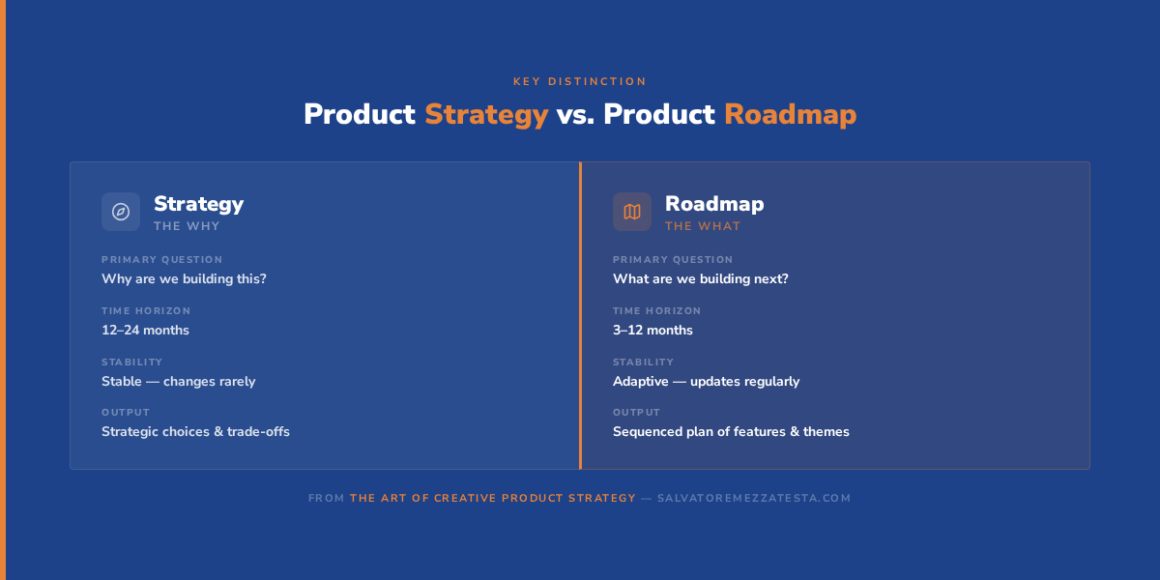
Before exploring the relationship between strategy and roadmap, it is worth establishing precise definitions. Imprecise language is often where the confusion begins.
A product roadmap is the sequenced plan of what your team will build, in what order, over a defined timeframe. It is tactical, adaptive, and designed to be updated regularly as you learn. A roadmap answers the question: Given our strategy, what should we build next, and when?
A product strategy is the set of deliberate choices that determine how your product will achieve its vision, which markets to compete in, which users to serve, which capabilities to build, and which trade-offs to accept. It is directional, durable, and designed to remain stable for 12–24 months. As explored in the product strategy definition article in this series, strategy answers the question: Given where we want to go, what choices will get us there?
The relationship between them is hierarchical: strategy sets the direction, and roadmap translates that direction into a sequence of work. One does not replace the other. They operate at different levels of abstraction and on different timescales.
| Dimension | Product Strategy | Product Roadmap |
|---|---|---|
| Primary question | Why are we building this? | What are we building next? |
| Time horizon | 12–24 months | 3–12 months |
| Stability | Stable (changes rarely) | Adaptive (changes regularly) |
| Audience | Leadership, investors, whole org | Team, stakeholders, customers |
| Output | Strategic choices & trade-offs | Sequenced plan of features/themes |
| Failure mode | Too vague or too reactive | Disconnected from strategy |
Why Confusing Them Is Expensive
When teams treat the roadmap as the strategy — or worse, when they have a roadmap but no strategy — several predictable problems emerge.
Problem 1: The roadmap becomes a wish list. Without strategic filters, every stakeholder request, every customer complaint, and every competitor feature gets added to the roadmap. The team is perpetually busy but never making progress toward anything meaningful. This is the most common symptom of strategy-less roadmapping, and it is exhausting for everyone involved.
Problem 2: Prioritization becomes political. When there is no strategic framework to evaluate roadmap items against, decisions default to whoever has the most influence. Engineering wants to refactor. Sales wants the enterprise feature. Marketing wants the integration. Without strategy, there is no principled way to choose — and the loudest voice wins.
Problem 3: The product loses coherence. A roadmap built without strategic guidance tends to produce a product that does many things adequately and nothing exceptionally. Features accumulate without a unifying logic, and users struggle to understand what the product is actually for. This is the product equivalent of misaligned vision: a collection of parts that never becomes a whole.
Problem 4: Teams lose motivation. When people cannot see how their daily work connects to a larger purpose, engagement drops. A roadmap without strategy is just a task list. A roadmap grounded in strategy is a narrative — and narratives are what motivate people to do their best work.
How Strategy Guides Roadmap Decisions
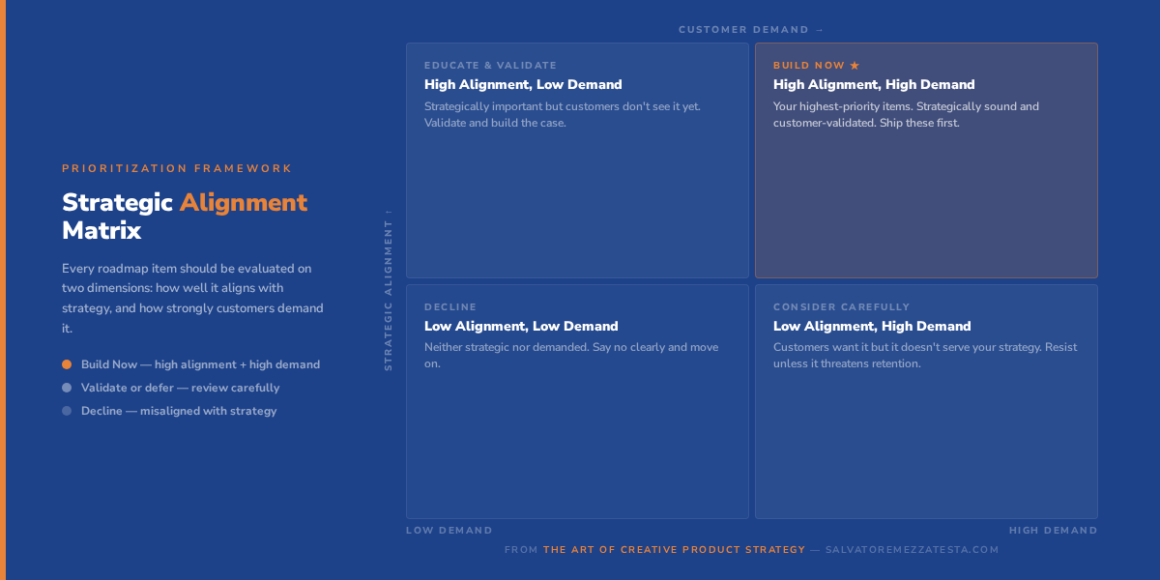
The practical relationship between strategy and roadmap works through a set of strategic filters, questions that every roadmap item must answer before it earns a place in the plan.
The most useful filter is the simplest: Does this item bring us closer to our strategic goals? If the answer is no, the item does not belong on the roadmap, regardless of how much a customer wants it, how easy it is to build, or how loudly a stakeholder is asking for it. Strategy is a decision-making tool, and its most important function is giving you a principled reason to say no.
A second filter is strategic sequencing: not just whether an item is strategically relevant, but whether it is the right item right now. Strategy implies trade-offs across time. Building the enterprise dashboard before you have product-market fit in the SMB segment might be strategically valid in the long run but tactically premature. A good roadmap reflects not just strategic alignment but strategic timing.
A third filter is opportunity cost: every item on the roadmap displaces something else. When you add Feature X, you are implicitly choosing not to build Feature Y. Strategy makes this trade-off explicit. The OKR framework, popularized by John Doerr and widely used in product organizations, is one of the most effective tools for making this connection visible — by tying roadmap items directly to measurable strategic objectives.
Same Strategy, Different Roadmaps
One of the clearest illustrations of the strategy-roadmap relationship is what happens when the same strategy produces different roadmaps for different markets or contexts.
Consider a company with a clear strategic choice: We will win the mid-market segment by being the easiest product to onboard without IT support. That strategy is stable and directional. But the roadmap that executes it will look different depending on the market:
- In the US market, where self-serve adoption is high, the roadmap prioritizes in-app onboarding flows, interactive tutorials, and a freemium tier.
- In the European market, where data privacy concerns are higher, the roadmap prioritizes GDPR compliance documentation, regional data hosting, and a dedicated privacy dashboard.
- In the enterprise segment, where IT involvement is unavoidable, the roadmap prioritizes SSO integration, admin controls, and security certifications.
The strategy is identical across all three. The roadmaps are different, because the roadmap is the strategy’s response to local context. This is a critical insight: a good strategy does not prescribe a single roadmap; it provides a framework for building the right roadmap for each context.
Building a Roadmap That Stays True to Strategy
The most common failure mode in strategic roadmapping is not a lack of good intentions buta lack of structural discipline. Teams that want to stay strategic get pulled off course by urgent requests, shiny features, and competitive pressure. Here is a practical approach to maintaining the connection between strategy and roadmap over time.
Start with strategic themes, not features. Rather than listing features on your roadmap, organize it around strategic themes — the areas of investment that directly serve your strategic goals. A theme might be “reduce time-to-first-value” or “expand enterprise readiness.” Features live within themes, and themes connect directly to strategy. Tools like Productboard and Aha! are designed around this theme-based approach, making it easier to maintain the strategy-roadmap link at scale.
Review the roadmap against strategy quarterly. Every quarter, ask: has our strategy changed? If not, does our roadmap still reflect it? If yes, what needs to change on the roadmap? This cadence prevents strategic drift — the gradual accumulation of roadmap items that are individually defensible but collectively misaligned.
Make the strategic rationale visible. For every significant roadmap item, document the strategic reason it is there. This is not bureaucracy — it is a forcing function. If you cannot articulate why an item is strategically important, it probably should not be on the roadmap. Miro’s roadmap templates include fields for strategic context precisely because teams that document the “why” make better prioritization decisions.
Use the roadmap to communicate strategy, not just plans. A well-structured roadmap is one of the most effective tools for communicating strategic direction to stakeholders, customers, and team members. When people understand why you are building what you are building and not just what you are building, they engage differently. They ask better questions, surface better insights, and make better decisions in their own domains.
The Role of Vision in the Strategy-Roadmap Chain
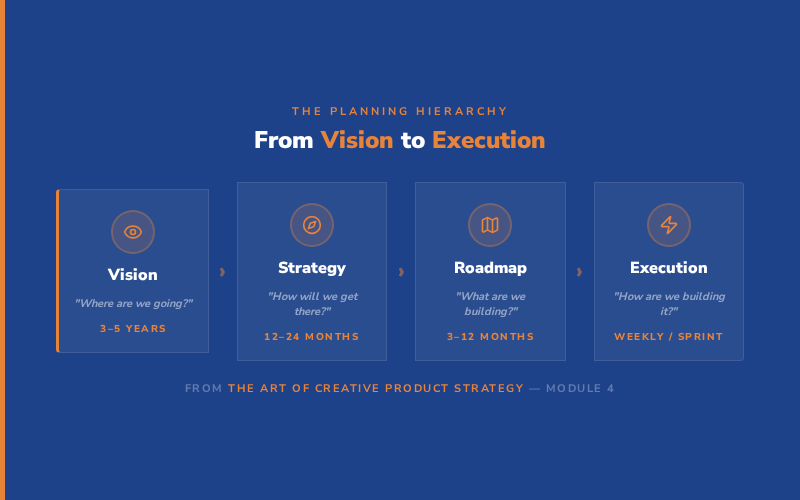
It is worth noting that strategy and roadmap do not exist in isolation but they are part of a larger hierarchy that begins with vision. As explored in the article on vision alignment, vision is the apex of the planning hierarchy: the declaration of the future state your product is working toward. Strategy is the set of choices that will get you there. Roadmap is the sequence of work that executes those choices.
This three-level hierarchy — vision, strategy, roadmap — is what makes product planning coherent. Without vision, strategy has no destination. Without strategy, roadmap has no direction. Without roadmap, vision and strategy remain abstract. Each level depends on the others, and the failure of any one level cascades downward.
This is also why strategic thinking is the foundational skill for product leaders — not roadmap management, not feature prioritization, not stakeholder communication. Those skills matter, but they are downstream of the ability to think clearly about where you are going and why.
Tools and Templates for Strategic Roadmapping
Several tools are designed specifically to help teams maintain the connection between strategy and roadmap. The right choice depends on your team size, workflow, and the level of strategic visibility you need.
- Productboard is purpose-built for strategic product management. It allows teams to link features to strategic objectives, score items against custom criteria, and generate roadmap views that reflect strategic priorities rather than just timelines.
- Aha! offers a comprehensive planning suite that connects vision, strategy, and roadmap in a single tool. Its “strategy roadmap” view is particularly useful for communicating strategic context to leadership and stakeholders.
- Miro provides flexible visual roadmap templates that work well for teams that need to customize their roadmap structure. Its strength is collaboration — making it easy for cross-functional teams to build and review roadmaps together.
For teams that prefer a simpler approach, a well-structured spreadsheet or Notion document organized by strategic themes with explicit rationale for each item, can be just as effective as a dedicated tool. The tool matters less than the discipline of maintaining the strategy-roadmap connection.
Conclusion
The difference between product strategy and product roadmap is not semantic. It is structural, and getting it right is one of the most important things a product leader can do for their team, their product, and their organization.
Strategy sets the direction. Roadmap translates that direction into action. When they are aligned, teams move with clarity and purpose. When they are confused or disconnected, teams are busy but not productive, reactive but not strategic, building but not winning.
If your roadmap debates feel endless, your prioritization feels political, or your product feels incoherent, the root cause is almost always a strategy problem, not a roadmap problem. Fix the strategy first, and the roadmap will follow.
Get the Full Strategic Planning Framework
The Art of Creative Product Strategy covers the complete planning hierarchy, from vision development to strategic choice-making to roadmap construction, across ten modules designed for product leaders who want to build products that matter. Get the full book on Amazon and build the strategic planning toolkit your team needs.
You can also explore the creative product strategy framework in the book’s landing page, including the table of contents and a preview of the methodology.
Frequently Asked Questions
Q1: Can we have a product roadmap without a product strategy?
Yes — but what you will have is a feature list, not a roadmap. Without strategy, your roadmap has no direction. It becomes a collection of things to build, organized by whoever asked most recently or argued most loudly. A strategic roadmap is organized around achieving specific goals. Without those goals, prioritization is arbitrary and alignment is impossible.
Q2: How detailed should a product roadmap be?
It depends on the audience and the timeframe. High-level roadmaps — three to five themes or initiatives per quarter — are appropriate for leadership, investors, and customers. Detailed roadmaps — ten to twenty items per sprint — are appropriate for engineering and design teams. The mistake is using the same level of detail for every audience. Match the granularity to the conversation.
Q3: How often should we update the product roadmap?
Review the roadmap quarterly against your strategy, update it monthly based on new learnings, and adjust it weekly based on execution realities. A roadmap that never changes is either perfect — which is unlikely — or disconnected from reality — which is more likely. Adaptability is a feature, not a weakness.
Q4: What is the difference between a product roadmap and a release plan?
A roadmap is strategic: it describes what you are building and why, organized by themes or goals, looking six to twelve months ahead. A release plan is tactical: it describes when you are shipping specific features and to whom, looking one to three months ahead. Both are necessary; neither replaces the other. Confusing them leads to over-committing on timelines and under-communicating on strategy.
Q5: Should we share our product roadmap with customers?
Yes, but selectively. Share a high-level, vision-aligned roadmap that communicates your strategic direction and excites customers about where you are going. Do not share detailed timelines or specific features that are likely to change. Transparency builds trust; over-commitment creates problems. The goal is to give customers confidence in your direction, not to lock yourself into specific deliverables.
Q6: How do we prioritize what goes on the product roadmap?
Use a framework that is explicitly tied to your strategy. Common approaches include impact vs. effort scoring, strategic alignment vs. customer demand matrices, and OKR-based prioritization. Whatever framework you use, the key is that it connects back to your strategic vision — not just to what is easiest to build or what customers are asking for most loudly.
Q7: What if the roadmap and strategy conflict?
Stop and resolve the conflict before proceeding. Either your strategy is wrong — in which case, update it — or your roadmap is wrong — in which case, revise it. You cannot execute a roadmap that contradicts your strategy without creating confusion, wasted effort, and organizational misalignment. The conflict itself is valuable information: it tells you that something in your planning hierarchy needs attention.
Q8: Can we have a roadmap with no dates?
Yes, and often you should. A roadmap organized by quarters or strategic themes is more flexible than one with hard dates. Hard dates create false certainty, make it harder to adapt to new learnings, and set up your team for the demoralizing experience of consistently missing commitments. Theme-based or now/next/later roadmaps are increasingly common precisely because they communicate strategic direction without over-committing on timing.
Q9: How do we handle roadmap requests from customers or stakeholders?
Evaluate every request against your strategy. If it aligns with your strategic goals, consider it seriously. If it does not, explain why it is not on the roadmap — and use the strategy as your explanation. This is where strategy becomes practically powerful: it gives you a principled, non-political reason to say no. “That is not aligned with our current strategic focus” is a much stronger answer than “we do not have capacity.”
Q10: Should product managers own the roadmap, or should it be collaborative?
The roadmap should be built collaboratively — with input from product, design, engineering, and leadership — but owned by product. The product manager’s role is to facilitate the strategic conversation, synthesize the inputs, and make final prioritization calls based on the strategy. Collaborative input without clear ownership leads to roadmaps that try to satisfy everyone and end up satisfying no one.