Every product team lives on a spectrum.
At one end: pure creativity. Wild ideas, blue-sky thinking, concepts that challenge every assumption. At the other end: pure feasibility. Safe iterations, incremental improvements, the path of least resistance. Most teams don’t consciously choose where they sit on this spectrum, but rather drift toward one extreme or the other, and both extremes are dangerous.
The teams that sit too far toward creativity produce brilliant ideas that never ship. The teams that sit too far toward feasibility produce safe iterations that don’t matter. The art of creative product strategy is finding the position on that spectrum that lets you ship bold ideas that are genuinely differentiated and genuinely buildable.
This article is about how to find that position deliberately, and how to hold it under pressure.
The Two Danger Zones
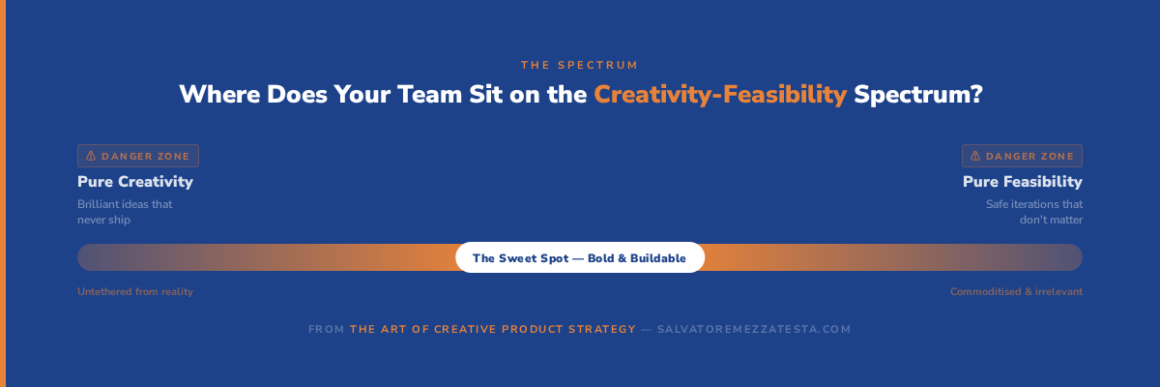
The creativity-feasibility spectrum has two failure modes, and both are common.
The creativity trap is where teams fall in love with ideas rather than outcomes. They generate concepts that are genuinely novel — but untethered from user needs, technical reality, or business constraints. These ideas are exciting in workshops and invisible in the market. The team spends months on a vision that never ships, or ships something so far ahead of the market that no one is ready for it.
The feasibility trap is subtler and more common. It’s the team that always builds what’s safe — the incremental feature, the minor improvement, the “let’s just do what competitors are doing.” This approach feels responsible. It isn’t. It leads to commoditisation. When every decision is filtered through “can we build this quickly?”, you end up with a product that is technically sound and strategically irrelevant.
The goal is not to avoid risk. The goal is to take the right risks: creative bets that are grounded in user insight, aligned with your roadmap execution, and scoped to be shippable.
A Framework for Assessing Creative Ideas
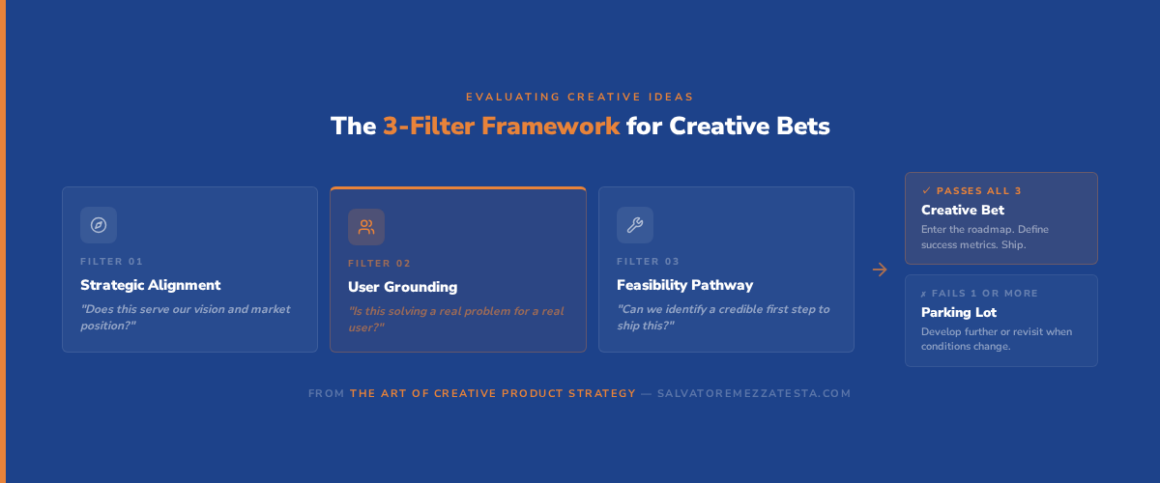
The question is not “is this idea creative?” The question is “is this idea creative and feasible and strategically aligned?” Those three filters, applied together, separate the ideas worth pursuing from the ideas worth admiring.
Here is a practical three-filter framework for evaluating any creative idea before committing resources to it.
Filter 1: Strategic alignment. Does this idea serve your vision? Does it move you toward the market position you’re trying to occupy? A creative idea that doesn’t align with your strategy is a distraction, however brilliant it may be. This filter eliminates the ideas that are interesting but irrelevant.
Filter 2: User grounding. Is this idea solving a real problem for a real user? Creative ideas that aren’t anchored in user insight tend to be solutions in search of a problem. This filter connects creativity to the strategic thinking that should underpin every product decision.
Filter 3: Feasibility pathway. Can you identify a credible path to shipping this? Not “can we build the full vision today?” but “can we ship a version of this that tests the core creative insight?” If you can’t sketch a feasible first step, the idea isn’t ready — it needs more development before it enters the roadmap.
Ideas that pass all three filters are your creative bets. Ideas that fail one or more filters go back to the drawing board — or into a parking lot for later.
Case Study: Netflix’s Creative Bets
Netflix’s history is a masterclass in creativity-feasibility balance. The company has made several bets that looked creatively bold at the time and turned out to be strategically decisive.
The most cited example is House of Cards in 2013, Netflix’s first major original production. The creative bet was significant: instead of licensing content, Netflix would produce it. Instead of commissioning a pilot and waiting for audience response, they would commit to a full season upfront. The feasibility pathway was grounded in data: Netflix’s viewing data showed that subscribers who liked David Fincher’s films and Kevin Spacey’s performances were a large, identifiable segment. The creative bet was bold; the feasibility case was evidence-based.
The same pattern applies to Netflix’s algorithmic personalisation. The idea of replacing a traditional content catalogue with a personalised recommendation engine was creatively disruptive. But it was built incrementally, tested, measured, and iterated over years before it became the dominant interface. As Netflix’s technology blog has documented, the recommendation system was not a single creative leap but a series of feasible steps, each grounded in user behaviour data.
The lesson is not that Netflix was lucky. It is that they applied the creativity-feasibility framework consistently: bold vision, evidence-based feasibility, incremental execution. That combination is what market adaptation looks like when it’s done well.
How to Build a Culture That Ships Bold Ideas
Frameworks are necessary but not sufficient. The creativity-feasibility balance is ultimately a cultural challenge. Teams default to the feasibility trap not because they lack creative ideas, but because the organisational environment punishes creative risk and rewards safe execution.
Three cultural practices make a measurable difference.
Make it safe to propose bold ideas. In most teams, proposing a genuinely creative idea is a social risk. If the idea gets rejected, the proposer looks naive. If it gets approved and fails, the proposer gets blamed. This dynamic kills creative thinking at the source. Leaders who want creative teams need to explicitly reward the quality of thinking, not just the outcome of execution. Harvard Business Review’s research on psychological safety consistently shows that teams where members feel safe to take interpersonal risks produce more innovative outcomes.
Use a portfolio approach. Not every initiative needs to be a creative bet. A healthy product portfolio allocates roughly 70% of resources to core improvements, 20% to adjacent innovations, and 10% to transformational bets. This framing, sometimes called the 70-20-10 innovation model, gives teams permission to take creative risks within a bounded allocation, rather than treating every decision as a binary choice between safe and bold.
Measure creative bets differently. Applying standard velocity or conversion metrics to a creative bet is a category error. Creative bets need their own success criteria, defined before the work begins: What would we need to see to know this bet is working? What would we need to see to know it’s time to pivot? Defining these criteria in advance prevents the retrospective rationalisation that kills learning.
Connecting to the Book
The creativity-feasibility balance is one of the central tensions explored in The Art of Creative Product Strategy. The book provides a full toolkit for navigating this tension — from the spectrum framework to the portfolio model to the cultural practices that make bold ideas shippable.
Ready to master the creativity-feasibility balance?
The Art of Creative Product Strategy gives you the complete framework — from the spectrum model to the portfolio approach to the cultural practices that make bold ideas shippable.
Want a free taste first?
Download Module 1 free and start building your strategic foundation today.
Frequently Asked Questions
Q1: How do we know if an idea is creative or just risky?
A creative idea solves a real problem in a novel way. A risky idea is simply untested. The distinction matters: ask “Does this solve a real customer problem?” If yes, the novelty is creative. If no, the novelty is just exposure to downside. Creativity without user grounding is not a strategic asset — it’s a liability.
Q2: What’s the optimal balance between creativity and feasibility?
There is no universal ratio. It depends on your market position and risk tolerance. New entrants competing against established players need more creativity — incremental improvements won’t differentiate them. Established products with large user bases can afford more feasibility — they have more to lose from instability. The right balance is the one that serves your strategic position, not a fixed formula.
Q3: How do we get engineering buy-in for creative ideas?
Engineers care about feasibility, but they also care deeply about impact. The most effective approach is to involve engineering early in the creative process — not to approve ideas, but to shape them. Engineers who help define the feasibility pathway are far more committed to the outcome than engineers who receive a finished spec and are asked to build it.
Q4: Can we ship a creative idea incrementally?
Yes, and you almost always should. The goal is to identify the core creative insight — the thing that makes the idea genuinely different — and find the smallest feasible version of it that tests whether the insight is real. Ship that first. Iterate from there. This approach reduces risk while preserving the creative vision.
Q5: How do we measure the success of a creative bet?
Define success metrics before you ship, not after. For creative bets, relevant metrics might include adoption rate among the target segment, user sentiment on the differentiating feature, or strategic alignment indicators. Do not measure creative bets using the same metrics as incremental improvements — the time horizons and success patterns are different.
Q6: What if a creative idea fails?
The question is not “did it succeed?” but “did we learn something valuable?” A fast failure that generates a clear insight is a good bet. A slow failure that generates no learning is a bad bet. The distinction is not in the outcome but in the quality of the hypothesis and the speed of the feedback loop.
Q7: How do we build a culture that supports creative feasibility?
Celebrate creative failures alongside successes. Give teams explicit permission to experiment. Tie recognition to the quality of strategic thinking, not just execution outcomes. And protect creative bets from the metrics frameworks designed for incremental work — applying the wrong measurement to a creative bet will kill it before it has a chance to prove itself.
Q8: Can a large organisation be creative?
Yes, but it requires deliberate culture-building. Large organisations default to safety because the cost of failure is higher and the visibility of failure is greater. Leaders who want creative organisations need to actively protect teams from excessive risk-aversion, create bounded spaces for experimentation, and model the behaviour they want to see.
Q9: How do we balance creative bets with incremental improvements?
The portfolio approach is the most practical answer. Allocate a defined percentage of resources to creative bets — typically 20–30% — and the remainder to incremental work. This makes the trade-off explicit and prevents creative bets from being crowded out by the constant pressure of day-to-day execution.
Q10: What’s the difference between creative product strategy and creative execution?
Creative strategy is about what problem you solve and why you solve it that way. Creative execution is about how you build the solution. Both matter, but strategy comes first. A beautifully executed boring strategy is still boring. The creativity that creates market differentiation lives at the strategic level — in the choice of problem, the framing of the solution, and the positioning in the market.