
The Growth Trap
There is a particular kind of success that looks impressive from the outside and feels hollow from the inside. User numbers are up. Revenue is growing. The team is shipping fast. And yet, something is wrong. Retention is declining. The product is accumulating technical debt faster than it can be repaid. Customers are churning at a rate that growth is barely outpacing. The roadmap is a list of features designed to acquire users, not to serve them.
This is the growth trap — and it is one of the most common failure modes in product strategy. Teams optimise for the metrics that are easiest to grow in the short term: new user acquisition, feature count, monthly active users. They build for the press release, not for the customer. And in doing so, they undermine the very foundations of the long-term value they are trying to create.
Understanding what product strategy actually means is the starting point for escaping this trap. Strategy is not a growth plan. It is a value creation plan — and value created sustainably compounds over time in ways that growth-hacked metrics never do.
This article makes the case for sustainable product strategy, provides a practical framework for making long-term decisions without sacrificing short-term momentum, and shows how the companies that win over decades do so by building for value, not for vanity.
What Sustainable Product Strategy Actually Means
Sustainable product strategy is not about slowing down. It is not about being cautious, conservative, or risk-averse. It is about making decisions that create compounding value — decisions whose benefits grow over time rather than decay.
The distinction is clearest in how different companies think about their most important metric. Growth-oriented teams optimise for new user acquisition — because it is the fastest way to show progress. Sustainable teams optimise for customer lifetime value — because it is the truest measure of the value the product creates. The difference in long-term outcomes between these two orientations is enormous.
Reforge’s research on retention and growth demonstrates this compounding effect clearly: a product that retains 10% more of its users each month does not grow 10% faster — it grows exponentially faster, because retained users generate referrals, reduce acquisition costs, and provide the feedback that improves the product for future users. Retention is not just a metric — it is the mechanism through which sustainable products create value.
Sustainable product strategy also means making decisions with a longer time horizon. Most product teams plan in quarters. The best product strategists plan in years — not because they ignore quarterly results, but because they understand that the decisions that create the most value often take twelve to twenty-four months to show up in the metrics. Building a product vision that is genuinely long-term is the first prerequisite for sustainable strategy.
The Four Pillars of Sustainable Product Strategy
Sustainable product strategy is built on four interconnected pillars. Each one is a deliberate choice to optimise for long-term value over short-term metrics.
Pillar 1: Retention Over Acquisition
The most sustainable growth engine is a product that people keep using. Acquisition is expensive and competitive; retention is compounding and defensible. Before investing in growth, invest in understanding why users leave — and fix the underlying product problems that drive churn. A product with 90% monthly retention is fundamentally more valuable than a product with 50% retention and twice the acquisition budget.
Amplitude’s Product Intelligence report consistently shows that the top quartile of product-led growth companies achieve their growth not through paid acquisition but through product improvements that increase activation and retention. The product is the growth engine — but only if it is genuinely valuable to the people who use it.
Pillar 2: Outcomes Over Outputs
Sustainable teams measure what users achieve with the product, not what the product ships. The distinction between outputs (features shipped, releases deployed, velocity) and outcomes (user goals achieved, problems solved, value delivered) is the most important conceptual shift in modern product management — and it is the foundation of sustainable strategy.
When teams are measured on outputs, they optimise for shipping. When they are measured on outcomes, they optimise for value. Teresa Torres’s continuous discovery framework is built on this principle: the purpose of product development is not to ship features — it is to create outcomes for users that also create value for the business. Sustainable products are those where these two things are genuinely aligned.
Pillar 3: Trust as a Strategic Asset
The most durable competitive advantage a product can build is user trust. Trust is built slowly, through consistent delivery of value, transparent communication, and respect for user data and attention. It is destroyed quickly, through dark patterns, broken promises, and decisions that prioritise short-term engagement over long-term wellbeing.
Apple’s approach to privacy is the clearest recent example of trust as a strategic asset. By positioning privacy as a product feature — not just a compliance requirement — Apple has built a differentiated position that is genuinely difficult for competitors to replicate. Apple’s privacy framework is not just an ethical stance; it is a strategic one. It creates switching costs, drives premium pricing, and generates the kind of brand loyalty that advertising cannot buy.
Pillar 4: Ethical Decision-Making as a Competitive Advantage
Ethical product decisions are not just the right thing to do — they are increasingly a source of competitive advantage. Consumers, employees, and investors are all paying more attention to how companies make decisions about user data, algorithmic fairness, environmental impact, and labour practices. Companies that embed ethical decision-making into their product strategy are building resilience against regulatory risk, reputational risk, and talent risk simultaneously.
The B Corp certification framework provides a useful structure for thinking about ethical product decisions across five dimensions: governance, workers, community, environment, and customers. While B Corp certification is not relevant for every product company, the framework’s questions are valuable for any product leader who wants to think systematically about the long-term impact of their decisions.
Case Study: How Basecamp Built a Sustainable Product Business
Basecamp is one of the most instructive examples of sustainable product strategy in the software industry — not because it is the largest or fastest-growing, but because it has been profitable, independent, and genuinely valuable to its customers for over twenty years.
The company’s approach to product strategy is explicitly anti-growth-trap. Founders Jason Fried and David Heinemeier Hansson have written extensively about their decision to optimise for profitability and customer value rather than for growth metrics and venture capital. Their product decisions reflect this orientation: Basecamp has never added features to acquire users — only to serve them better. They have deliberately kept the product simple, resisting the feature bloat that afflicts most SaaS products as they scale.
The result is a product with extraordinarily high retention, a customer base that has stayed for years rather than months, and a business that generates consistent profit without the existential pressure of growth-at-all-costs. As Fried and Hansson describe in It Doesn’t Have to Be Crazy at Work, sustainable product strategy is not a constraint on ambition — it is a different kind of ambition. The ambition to build something that lasts.
The contrast with competitors that chose the growth-first path is instructive. Many of Basecamp’s early competitors raised large rounds, grew quickly, and either burned out or were acquired for parts. Basecamp is still here, still independent, still profitable — because it optimised for the right things from the beginning.
Understanding what strategic success actually looks like requires being honest about which metrics matter over the long term — and Basecamp’s twenty-year track record is a compelling answer to that question.
The Sustainable Strategy Framework: Three Decisions That Compound
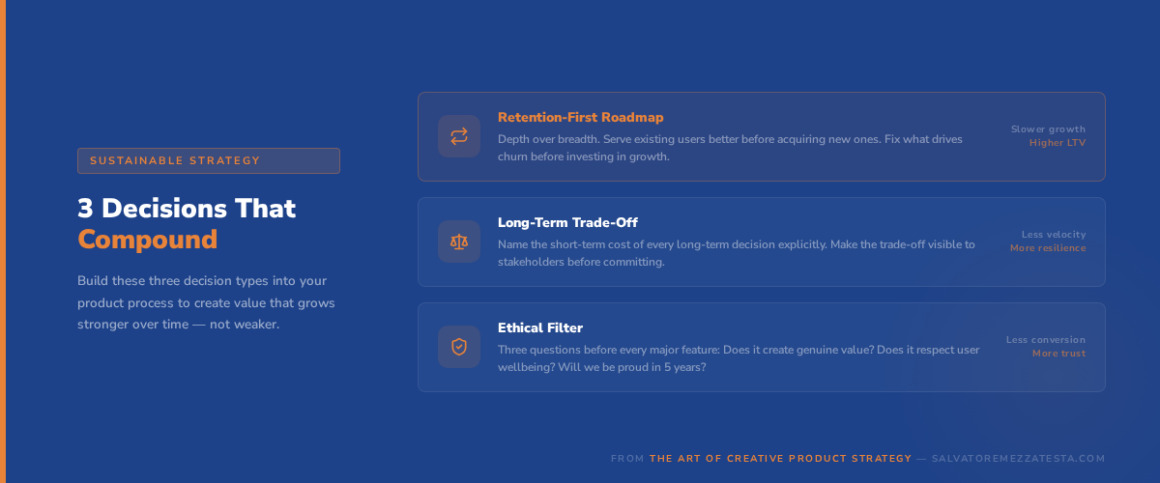
Sustainable product strategy is built through a series of small decisions, made consistently over time, that compound into a durable competitive position. Here is a framework for the three most important decision types.
Decision 1: The Retention-First Roadmap
Before adding any new feature, ask: “Does this improve the experience for users who are already here?” A retention-first roadmap prioritises depth over breadth — making the core product more valuable for existing users before expanding to new use cases or segments. This is counterintuitive for teams under growth pressure, but it is the decision that creates the most durable value.
Decision 2: The Long-Term Trade-Off
Every product decision involves a trade-off between short-term and long-term value. Dark patterns increase short-term conversion but destroy long-term trust. Technical debt enables short-term velocity but reduces long-term agility. Sustainable teams make these trade-offs explicitly — they name the short-term cost of the long-term decision and make it visible to stakeholders. Connecting decisions to a clear product vision is what makes these trade-offs defensible.
Decision 3: The Ethical Filter
Before shipping any significant feature, run it through three questions: “Does this create genuine value for users?” “Does this respect user data, attention, and wellbeing?” “Would we be proud of this decision in five years?” These questions are not a compliance checklist — they are a strategic filter that protects the trust that is your most durable competitive asset.
| Decision Type | Short-Term Cost | Long-Term Benefit |
|---|---|---|
| Retention-First Roadmap | Slower new user growth | Compounding retention + lower CAC |
| Long-Term Trade-Off | Reduced short-term velocity | Technical resilience + strategic agility |
| Ethical Filter | Foregone short-term conversion | Trust, brand loyalty, regulatory resilience |
Why Sustainable Strategy Is Now a Competitive Necessity
For most of the last decade, the growth-first approach was not just accepted — it was rewarded. Venture capital flowed to the fastest-growing companies regardless of unit economics or user wellbeing. Growth hacking was celebrated as a discipline. “Move fast and break things” was a philosophy, not a warning.
That era is ending. Regulatory pressure on data privacy, algorithmic fairness, and market concentration is increasing in every major market. Consumer awareness of dark patterns, attention manipulation, and data exploitation is growing. Talent — particularly the best engineers and designers — is increasingly choosing employers whose products they can be proud of.
In this environment, sustainable product strategy is not just ethically preferable — it is strategically necessary. The companies that built on growth-hacked foundations are facing increasing costs: regulatory fines, reputational damage, talent attrition, and the structural weakness of products that users tolerate rather than love.
The companies that built on sustainable foundations — genuine user value, earned trust, ethical decision-making — are finding that their foundations are increasingly valuable. They have lower regulatory risk, stronger brand loyalty, and the kind of strategic thinking culture that attracts the talent needed to keep building great products.
Sustainable product strategy is, in the end, the only strategy that works over the long term. The question is not whether to build sustainably — it is whether to start now or wait until the costs of not doing so become impossible to ignore.
Key Takeaways
- The growth trap is real. Optimising for short-term acquisition metrics at the expense of retention, trust, and user value creates a product that grows quickly and decays quickly. Sustainable strategy builds value that compounds.
- Retention is the most powerful growth engine. A product that people keep using generates referrals, reduces acquisition costs, and provides the feedback that improves the product for future users. Fix retention before investing in acquisition.
- Outcomes over outputs. Measure what users achieve with the product, not what the product ships. The purpose of product development is to create value for users — not to ship features.
- Trust is a strategic asset. Built slowly through consistent value delivery and ethical decision-making. Destroyed quickly through dark patterns and broken promises. Protect it with the same rigour you protect your revenue.
- Sustainable strategy is now a competitive necessity. Regulatory, reputational, and talent pressures are making the costs of growth-first strategy increasingly visible. The companies that built on sustainable foundations are finding those foundations increasingly valuable.
Ready to Build a Product Strategy That Lasts?
The sustainable strategy framework in this article is drawn from Module 9 of The Art of Creative Product Strategy — a full chapter on ethical considerations, sustainable practices, and the long-term thinking that separates products that endure from products that burn bright and fade. If you are serious about building a product that creates compounding value, the book gives you the complete framework.
Get The Art of Creative Product Strategy on Amazon →
Start with the foundations.
Before sustainable strategy, you need strategic clarity. Download Module 1 free and build the foundation that makes everything else possible.
Frequently Asked Questions About Sustainable Product Strategy
Q1: What is sustainable product strategy?
Sustainable product strategy is an approach to product development that prioritises long-term value creation over short-term growth metrics. It means making decisions that compound over time — investing in retention over acquisition, outcomes over outputs, trust over engagement, and ethical decision-making over short-term conversion. Sustainable strategy is not about slowing down; it is about building on foundations that strengthen rather than decay.
Q2: How is sustainable product strategy different from growth strategy?
Growth strategy optimises for the fastest path to scale — typically through acquisition, viral loops, and feature expansion. Sustainable strategy optimises for the most durable path to value — through retention, user outcomes, and trust. The two are not mutually exclusive, but they require different decision-making frameworks and different metrics. The most successful long-term companies combine growth thinking with sustainable foundations.
Q3: Does sustainable strategy mean sacrificing growth?
Not in the long run. In the short run, sustainable decisions sometimes involve trade-offs — investing in retention rather than acquisition, fixing technical debt rather than shipping new features, declining short-term conversion tactics that damage trust. But these trade-offs create the compounding foundations that make long-term growth possible. Companies with high retention grow faster over five years than companies with high acquisition and low retention.
Q4: How do we measure sustainable product strategy success?
The key metrics for sustainable strategy are: customer lifetime value (LTV), retention rate (monthly and annual), net promoter score (NPS), customer acquisition cost (CAC) relative to LTV, and revenue per user. These metrics tell you whether the value you are creating is durable. Vanity metrics — total users, page views, features shipped — tell you nothing about sustainability.
Q5: What are the most common unsustainable product decisions?
The most common are: optimising for engagement over wellbeing (maximising time-on-app at the expense of user outcomes), using dark patterns to drive conversion (misleading UI that tricks users into actions they did not intend), accumulating technical debt to ship faster (creating structural fragility that compounds over time), and prioritising acquisition over retention (spending on growth before fixing the product that drives churn).
Q6: How do we make the business case for sustainable strategy to investors or leadership?
Frame it in terms of unit economics. Show the LTV:CAC ratio of retained users versus acquired users. Show the cost of churn — not just the revenue lost, but the acquisition cost required to replace churned users. Show the regulatory and reputational risk of unsustainable practices. Sustainable strategy is not an ethical argument — it is a financial one. The numbers support it.
Q7: Can a startup afford to think sustainably, or is growth-first necessary early on?
Startups need to find product-market fit before they can think sustainably — and finding PMF sometimes requires moving fast and making imperfect decisions. But the transition from growth-first to sustainable thinking should happen as soon as PMF is established. The longer a startup waits to build sustainable foundations, the more expensive the transition becomes. The best time to start thinking sustainably is at the beginning; the second best time is now.
Q8: How does sustainable strategy relate to ethical product development?
They are deeply connected. Ethical product development — respecting user data, avoiding dark patterns, building for wellbeing — is the foundation of sustainable strategy. Products that exploit users may grow quickly, but they erode the trust that is the most durable source of competitive advantage. Ethical decisions are sustainable decisions; unsustainable decisions are almost always ethically questionable.
Q9: What role does product vision play in sustainable strategy?
A clear, long-term product vision is the prerequisite for sustainable strategy. Without a vision that extends beyond the next quarter, every decision defaults to short-term optimisation. Vision is the anchor that makes long-term trade-offs defensible — it gives you the language to explain why you are investing in retention rather than acquisition, or why you are declining a short-term revenue opportunity that conflicts with your strategic direction.
Q10: How do we build a sustainable strategy culture in a team that is used to growth-first thinking?
Start by changing what you measure and celebrate. If the team is rewarded for features shipped and users acquired, they will optimise for features and acquisition. If they are rewarded for retention, user outcomes, and trust, they will optimise for those. Culture follows incentives. Change the metrics, celebrate the right decisions, and model the long-term thinking you want to see. It takes time, but it compounds — just like the strategy itself.