
A vague vision is worse than no vision at all.
When a vision is absent, teams know they need direction. When a vision exists but is fuzzy — “We want to be the best product in our space” or “We aim to delight our customers” — it creates the dangerous illusion of alignment. Everyone nods in agreement. Everyone interprets it differently. And six months later, you wonder why engineering built one thing, marketing is positioning another, and sales is promising a third.
A product vision statement is not a tagline. It is not a mission statement. It is the single most powerful strategic tool a product leader has — and most teams write it wrong.
This article gives you a step-by-step framework for crafting a product vision that is specific enough to guide decisions, ambitious enough to inspire action, and clear enough that every person on your team can explain it in one sentence. This approach is drawn directly from the methodology in The Art of Creative Product Strategy, which dedicates an entire module to vision development as the cornerstone of strategic alignment.
What a Product Vision Statement Actually Is
Before writing your vision, it helps to understand what it is — and what it is not.
A product vision is a declaration of the future state your product is working toward. It answers the question: If we succeed completely, what will be true about the world — and about our users — that is not true today?
It is not a mission statement (which describes what you do today). It is not a strategy (which describes how you will get there). It is not a roadmap (which describes what you will build next). The vision sits above all of these. As the editorial plan for this blog series explains, understanding the product strategy definition is the necessary foundation before vision work can begin, because vision without strategy is poetry, and strategy without vision is bureaucracy.
The clearest way to understand the difference is through contrast:
| Statement Type | Example | Time Horizon |
|---|---|---|
| Mission | “We help teams collaborate on documents in real time.” | Present |
| Vision | “A world where every team works as if they’re in the same room, regardless of geography.” | 3–5 years |
| Strategy | “We will win the knowledge-worker segment by out-integrating every competitor.” | 12–24 months |
| Roadmap | “Q3: Launch async video comments. Q4: Add AI-powered meeting summaries.” | 3–12 months |
The vision lives at the top of this hierarchy. Everything else flows from it.
The Three Elements of a Compelling Vision Statement
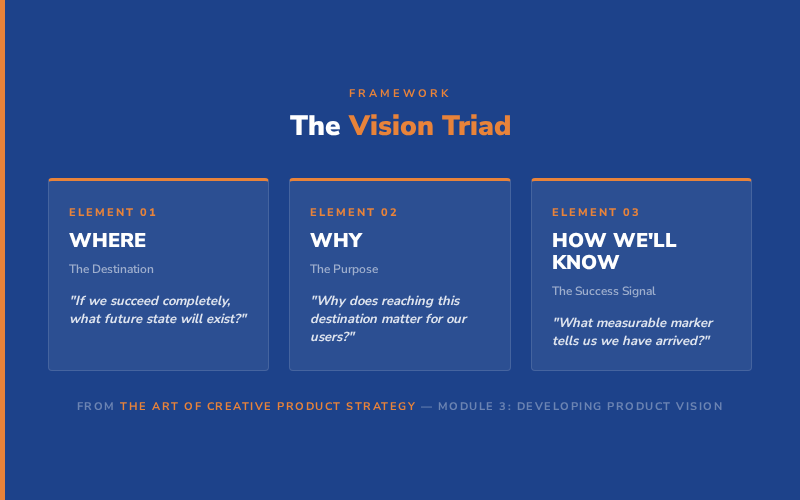
After studying dozens of product vision statements, from startups to enterprise companies, a pattern emerges. The most effective ones contain three distinct elements, which together form what I call the Vision Triad.
1. WHERE: The Destination
The vision must describe a specific future state. Not “we want to be great” but “we want to be the platform that eliminates the need for status meetings in distributed teams.” Specificity is what makes a vision useful as a decision-making filter. When your team debates whether to build Feature A or Feature B, the vision should make the answer obvious.
Apple’s original vision under Steve Jobs — “a computer in the hands of everyday people” — was specific about who the destination served (everyday people, not just engineers) and what the destination looked like (personal computing as a mass-market reality). That specificity guided every product decision for a decade.
2. WHY: The Purpose
A destination without a reason is a coordinate without meaning. The vision must articulate why reaching that destination matters, not just for the company, but for the people it serves. This is where vision connects to values and creates emotional resonance.
Airbnb’s vision — “Belong anywhere” — is powerful not because it describes a product feature, but because it articulates a human need: the desire to feel at home in the world, not like a tourist. That “why” has guided everything from their host onboarding experience to their brand photography to their community policies.
3. HOW WE’LL KNOW: The Success Signal
This is the element most teams omit, and it is the one that transforms a vision from inspiration into accountability. A compelling vision includes an implicit or explicit signal of what success looks like — a measurable marker that tells you when you have arrived.
Slack’s early vision — “to make your working life simpler, more pleasant, and more productive” — embedded its success signal in the language itself: simpler, more pleasant, more productive are all measurable dimensions. Their teams could ask, “Does this feature make work simpler?” and get a real answer.
When all three elements are present, you have a vision that can do the hardest job in product leadership: align a team of diverse, intelligent people around a shared direction without micromanaging every decision.
The Five Most Common Vision Mistakes
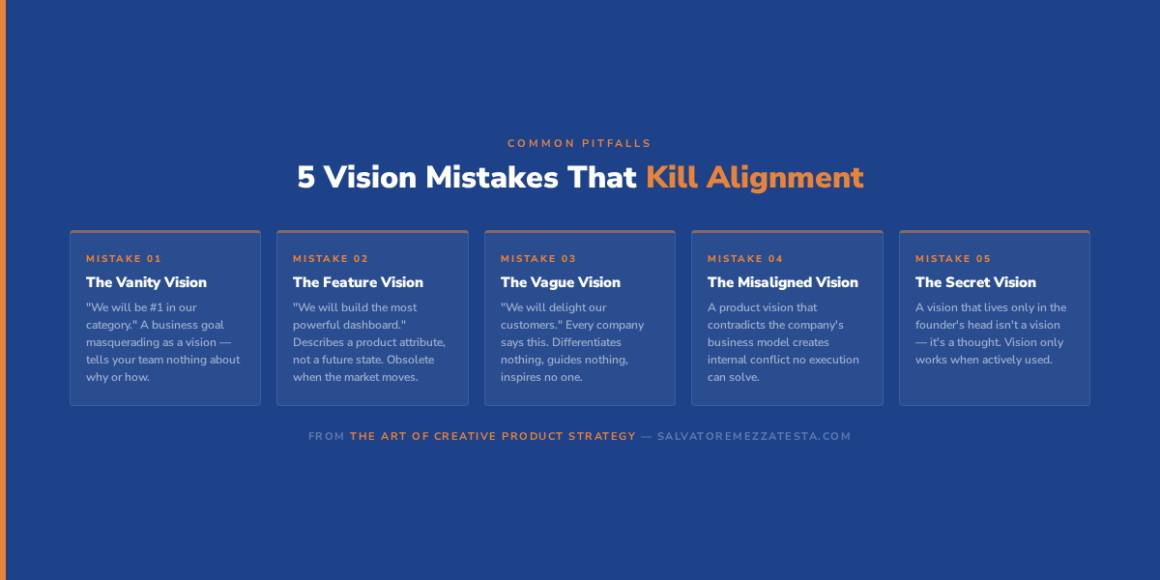
Most product vision statements fail for one of five reasons. Recognizing them is the first step to avoiding them.
Mistake 1: The Vanity Vision
“We will be the #1 product in our category.” This tells your team nothing about why you will be #1 or how being #1 serves your users. It is a business goal masquerading as a vision.
Mistake 2: The Feature Vision
“We will build the most powerful analytics dashboard on the market.” This describes a product attribute, not a future state. When the market moves and dashboards become commoditized, your vision becomes obsolete.
Mistake 3: The Vague Vision
“We will delight our customers and deliver exceptional value.” Every company says this. It differentiates nothing, guides nothing, and inspires no one. Vagueness is the enemy of alignment.
Mistake 4: The Misaligned Vision
A product vision that contradicts the company’s business model or strategic direction is worse than no vision — it creates internal conflict. If the company is pivoting to enterprise sales and the product vision is “the simplest tool for individual creators,” you have a problem that no amount of good execution will solve.
Mistake 5: The Secret Vision
A vision that lives in the founder’s head, or in a slide deck shown once at an all-hands and never mentioned again, is not a vision — it is a thought. Vision only works when it is repeated, visible, and actively used to make decisions. Research from the Harvard Business Review consistently shows that the most effective leaders communicate direction relentlessly, not once.
Step-by-Step Framework: How to Write Your Product Vision
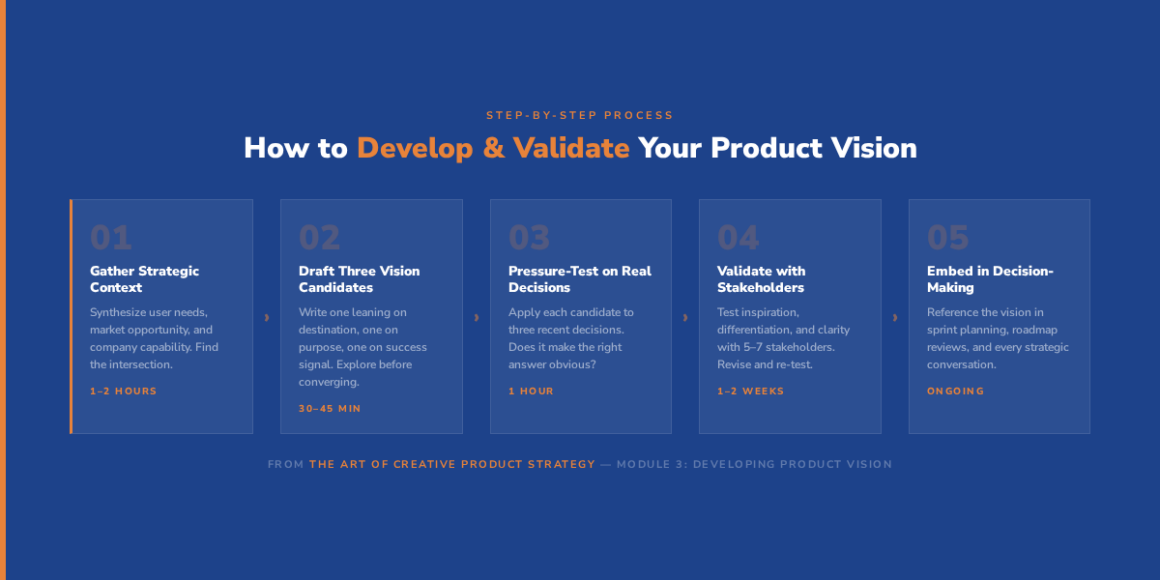
The following process is adapted from the Vision Development module in The Art of Creative Product Strategy. It is designed to be done collaboratively: not by a single leader in isolation, but with the key stakeholders who will need to execute against the vision.
Step 1: Gather Strategic Context (1–2 hours)
Before writing a single word, collect the raw material: Who are your target users? What problem are you solving that no one else solves as well? What does the market look like in 3–5 years? What does your company need to be true for the business to succeed?
This is not a brainstorming session. It is a synthesis session. You are looking for the intersection of user need, market opportunity, and company capability — the space where your vision can be both ambitious and achievable.
Step 2: Draft Three Vision Candidates (30–45 minutes)
Write three distinct vision statements, each emphasizing a different element of the Vision Triad. One that leans heavily on the destination. One that leans on the purpose. One that leans on the success signal. This forces you to explore the full space before converging.
Use this prompt template: “In [timeframe], [our product] will be [destination] because [purpose], and we will know we have succeeded when [success signal].”
You do not need to use this exact structure in your final vision — it is a drafting scaffold, not a formula.
Step 3: Pressure-Test Against Real Decisions (1 hour)
Take each vision candidate and apply it to three recent product decisions your team faced. Would this vision have made those decisions easier or harder? Would it have pointed clearly to the right answer, or left room for ambiguity?
A vision that cannot help you decide is not doing its job. This step is the most revealing, and the most commonly skipped.
Step 4: Validate with Stakeholders (1–2 weeks)
Share your top vision candidate with five to seven stakeholders: team members, leadership, and if possible, a few trusted customers or advisors. Ask three questions:
- Does this excite you? (Inspiration test)
- Does this differentiate us? (Positioning test)
- Can you explain it to someone else in one sentence? (Clarity test)
If the answer to any of these is no, revise and re-test. Vision validation is not a one-time event but an iterative process, much like the user research methods that inform strategic thinking more broadly.
Step 5: Embed the Vision in Decision-Making (Ongoing)
A vision only creates alignment if it is actively used. Build it into your team rituals: reference it in sprint planning, use it to evaluate roadmap items, cite it when declining feature requests. The goal is to make the vision the default frame for every strategic conversation.
This is where turning vision into roadmap becomes the practical next challenge and where many teams discover that their vision, while inspiring, is not yet specific enough to guide prioritization.
Real-World Vision Statements Worth Studying
Three examples that demonstrate the Vision Triad in action:
Apple (Steve Jobs era): “To make a contribution to the world by making tools for the mind that advance humankind.” The destination (tools for the mind), the purpose (advance humankind), and the success signal (contribution to the world) are all present and the vision has guided Apple’s product decisions for decades.
Airbnb: “Belong anywhere.” Deceptively simple, but the purpose (belonging, not just accommodation) is what differentiates Airbnb from every hotel chain and booking platform. It has guided their expansion into experiences, their community policies, and their brand identity.
Slack: “To make your working life simpler, more pleasant, and more productive.” The success signal is embedded in the adjectives — simpler, more pleasant, more productive — all of which are measurable and user-centric. Slack’s product decisions have consistently returned to this framing.
What these visions share is not poetic language or corporate ambition. They share specificity, user-centricity, and durability. They have held up across years of product evolution because they describe a future state, not a feature set.
How Vision Connects to the Broader Strategy
A product vision does not exist in isolation. It is the apex of a strategic hierarchy that flows downward into strategy, roadmap, and execution. Understanding this hierarchy is what separates product leaders who build coherent products from those who build impressive feature lists.
The product strategy definition describes strategy as the set of choices that determine how you will achieve your vision — which markets, which users, which capabilities, which trade-offs. Without a clear vision, strategy becomes arbitrary. With a clear vision, strategy becomes obvious: you simply ask, “Which choices bring us closest to the future state we have declared?”
This is also why misaligned vision is one of the most common root causes of product strategy failure. When the vision is unclear, every team interprets it differently, and the product fractures along those interpretive lines.
The Reforge framework for product strategy explicitly identifies vision as the foundation layer — the element that must be established before any other strategic work can be meaningful. Similarly, Mind the Product has published extensively on the relationship between vision clarity and team performance, consistently finding that teams with a clear, shared vision make faster and better decisions.
A Note on Vision for Early-Stage Teams
If you are leading a product at a startup or in an early-stage team, you may be tempted to defer vision work until you have “more data.” This is a mistake.
Vision is not a luxury for mature products. It is the most important tool you have when resources are scarce and every decision has outsized consequences. A clear vision helps you say no to the right things, which is the most valuable skill in early-stage product development.
The Y Combinator library consistently emphasizes that the startups that succeed are those that are ruthlessly clear about what they are building and why. Vision is that clarity, formalized.
Conclusion
A product vision statement is not a document you write once and file away. It is a living strategic tool that should shape every decision your team makes, every quarter, for years. The effort of crafting it well — with specificity, purpose, and a clear success signal — pays dividends in alignment, speed, and coherence that no amount of process improvement can replicate.
If your team is struggling with prioritization conflicts, roadmap debates, or stakeholder misalignment, the root cause is almost always a vision problem. Fix the vision, and the downstream problems often resolve themselves.
Get the Full Vision Development Framework
Module 3 of The Art of Creative Product Strategy is dedicated entirely to product vision: how to develop it, how to validate it, how to communicate it, and how to use it as a daily decision-making tool.
If you are ready to go deeper across all ten modules — from strategy fundamentals to execution and leadership — get the full book on Amazon and build the complete creative product strategy toolkit.
Frequently Asked Questions
Q1: What is a product vision statement?
A product vision statement is a declaration of the future state your product is working toward — a description of what will be true about the world and your users if your product succeeds completely. It is distinct from a mission statement (which describes what you do today) and a strategy (which describes how you will get there). A good vision is specific, inspiring, and durable enough to guide decisions for 3–5 years.
Q2: What is the difference between vision, mission, and purpose?
Vision is where you are going — the future state you are building toward. Mission is what you do today — the business you are in. Purpose is why you do it — the impact you want to have on the world. All three matter, but they serve different functions. Vision is strategic and forward-looking; mission is operational and present-tense; purpose is values-based and enduring. A product vision statement draws on all three but is primarily focused on the future destination.
Q3: How long should a product vision statement be?
A compelling vision can be as short as two or three words (“Belong anywhere”) or as long as two sentences. What matters is not length but clarity. If your vision requires a paragraph to explain, it is not yet clear enough. The test is whether every person on your team can recite it from memory and explain it to a stranger in one sentence. Clarity over comprehensiveness.
Q4: How far into the future should a product vision look?
Typically 3–5 years for most products. A one-year vision is not visionary — it is a roadmap. A ten-year vision risks becoming disconnected from market reality. The sweet spot is far enough to inspire ambitious thinking, close enough to feel achievable. Revisit the vision annually to ensure it still reflects your strategic direction, but resist the urge to rewrite it every time the market shifts.
Q5: How do we know if our product vision statement is compelling?
Apply three tests. First, the inspiration test: does your team get genuinely excited when they hear it? Second, the differentiation test: does it describe something that only your product is working toward, or could any competitor claim the same vision? Third, the clarity test: can a new hire explain it to a customer on their first week? If the answer to any of these is no, the vision needs refinement.
Q6: Should a product vision be aspirational or realistic?
Both — and this is the tension that makes vision work hard. A vision that is purely aspirational without grounding in market reality becomes fantasy. A vision that is purely realistic without ambition fails to inspire. The best visions are ambitious enough to differentiate and inspire, but grounded enough in user needs and market dynamics that your team believes they can actually get there. “We will be the #1 product in our category” is aspirational but not strategic. “We will be the product that eliminates the coordination tax for distributed teams” is both aspirational and specific.
Q7: How do we align the entire organization around a product vision?
Start by co-creating the vision with key stakeholders rather than presenting it top-down. People support what they help build. Then communicate it relentlessly — in all-hands meetings, team retrospectives, one-on-ones, and written communications. Make it visible: put it on the wall, in your Slack channel description, in your project briefs. Most importantly, use it actively to make decisions and explain those decisions. When people see the vision being used — not just stated — they begin to use it themselves.
Q8: What if different teams have different interpretations of the vision?
This is a sign of a vision clarity problem, not a team problem. If your vision is specific enough, it should not be open to multiple interpretations. When you discover that engineering, marketing, and sales have different mental models of where the product is going, go back to the vision itself. Is it specific enough? Does it include all three elements of the Vision Triad — destination, purpose, and success signal? Resolve the ambiguity at the vision level before trying to align teams at the execution level.
Q9: How do we validate that our vision resonates with the market?
Test it with customers, prospects, and market experts before committing to it. Does it resonate with the people you are building for? Do they understand it? Does it describe a future they want to live in? If the answer is no, refine it. Vision validation is not a one-time event — it is an ongoing process, especially in fast-moving markets. Treat your vision as a hypothesis, validate it with evidence, and update it when the evidence demands it.
Q10: Can a small startup have a product vision if resources are limited?
Absolutely — and in fact, startups need vision more than established companies. With limited resources, every decision has outsized consequences. A clear vision is what allows a small team to say no to the right things and yes to the right things, without needing a committee meeting for every decision. Many of the most powerful product visions in history were written by founders with no money, no team, and no product — just a clear picture of the future they were building toward.