What Is Product Strategy? (And Why It Matters More Than You Think)
Product strategy is one of the most misunderstood concepts in product management — and that misunderstanding is costing companies millions.
Most companies confuse product strategy with feature roadmaps. They sit down, brainstorm a list of features they want to build, slap a mission statement on top, and call it “strategy.” Then they’re confused when their product doesn’t differentiate in the market, their team doesn’t know what they’re building toward, and they’re constantly reacting to competitors instead of leading the market.
The result? Wasted resources, confused teams, and products that feel like a collection of features rather than a cohesive solution to a real problem.
But here’s the truth: a real product strategy isn’t a feature list. It’s a set of choices that make all other choices easier.
As Michael Porter argued in his seminal Harvard Business Review piece on competitive strategy, the essence of strategy is choosing what not to do. Most companies never make those hard choices — and it costs them everything.
In this article, I’ll break down what product strategy actually is, why most companies get it wrong, and how to build one that actually works.
The Real Definition of Product Strategy
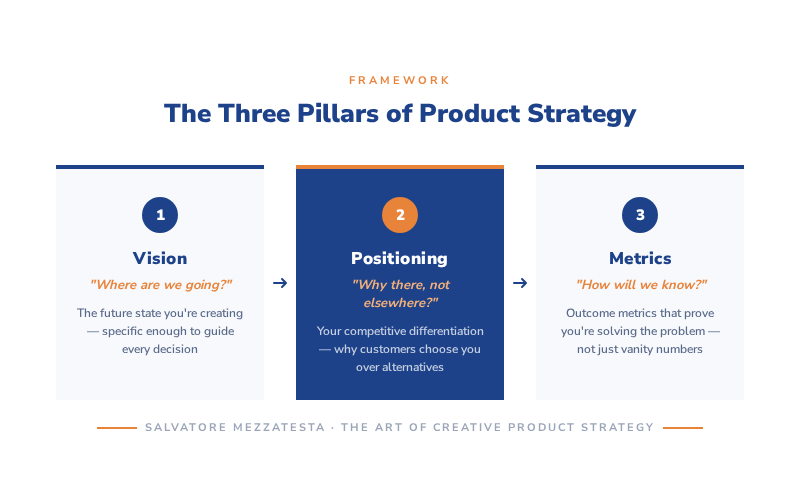
A product strategy is a long-term plan that answers three fundamental questions:
- Where are we going? (Vision)
- Why there and not somewhere else? (Positioning)
- How will we know we’ve arrived? (Metrics)
Without clear answers to all three questions, you don’t have a product strategy. You have a plan. Plans are useful for execution, but they’re not strategic.
Think of it this way: product strategy is the “what and why.” Execution is the “how.” If you’re struggling to turn your strategy into an actionable plan, understanding the difference between product strategy and product roadmap is a good place to start — they are not the same thing, and conflating them is one of the most common and costly mistakes in product development.
The Three Pillars of Product Strategy
1. Vision — Where Is Your Product Strategy Taking You?
Your vision is the future state you’re trying to create. It’s not a tagline or a mission statement — it’s a clear picture of what success looks like.
A strong vision answers: “What problem are we solving?” and “What will the world look like when we’ve solved it?” If you’re not sure how to articulate this clearly, crafting a compelling product vision is a skill worth developing deliberately — it’s what separates products that inspire from products that merely function.
Example: Slack’s vision isn’t “be a communication tool.” It’s “make work less of a mess.” That’s fundamentally different. One is a feature description. The other is a problem statement that guides every decision.
2. Positioning — Why Your Product Strategy Needs Differentiation
Positioning is your competitive differentiation. It’s why customers should choose you over alternatives.
Positioning answers: “What makes us different?” and “Who are we building for?”
Example: Figma’s positioning isn’t “a design tool.” It’s “the collaborative design tool for distributed teams.” That specific positioning shapes everything — from the product roadmap to the marketing message to the pricing model. Reforge’s writing on product positioning captures this well: positioning is not what you say about your product, it’s what your product is in the mind of the customer.
3. Metrics — How Your Product Strategy Measures Progress
Strategic metrics measure progress toward your vision. They’re not vanity metrics (total users, page views). They’re outcome metrics that prove you’re moving in the right direction.
Example: If your vision is “make work less of a mess,” your metrics might be: “% of teams that use Slack as their primary communication tool” or “average daily active users per workspace.” These measure whether you’re actually solving the problem, not just whether people are using your product. We cover how to define and measure strategic metrics in depth in a separate article.
Why Most Companies Get Product Strategy Wrong
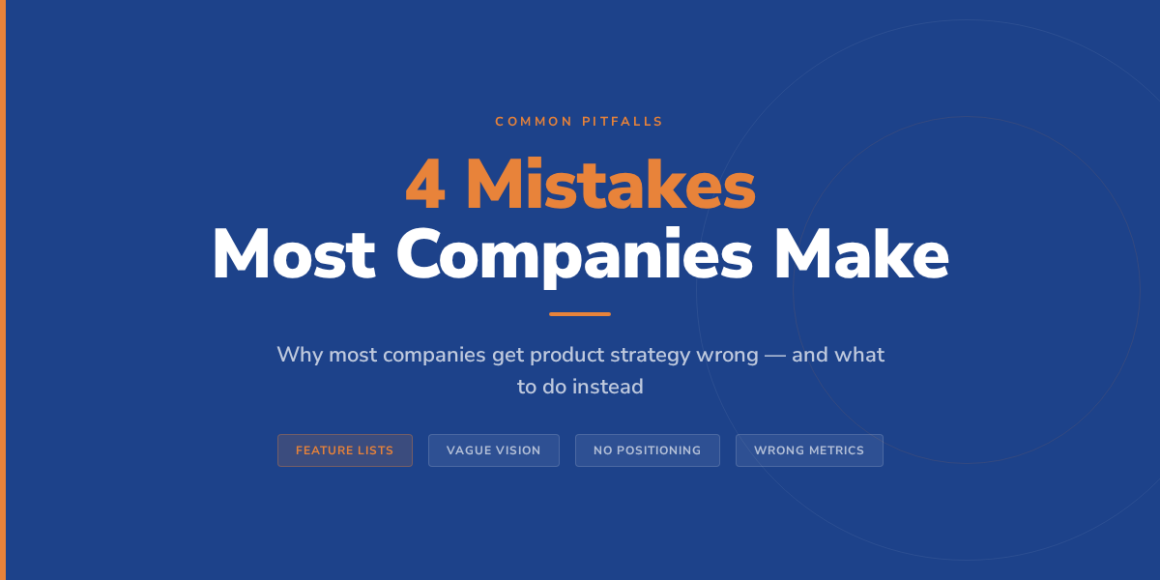
Understanding what product strategy is isn’t enough — you also need to understand the common failure modes. These four mistakes appear again and again across companies of all sizes.
Mistake #1: Confusing Product Strategy with Feature Lists
The most common mistake is treating your roadmap as your product strategy.
A roadmap is tactical. It says “we’re building X, Y, and Z in Q2.” A product strategy is strategic. It says “we’re solving problem X for audience Y because we believe we can own the market by doing Z.”
The roadmap should flow from the strategy. If your roadmap doesn’t ladder up to your strategic vision, you’re just building random features.
Red flag: If your strategy document reads like a feature list, you don’t have a product strategy.
Mistake #2: Vague Vision That Doesn’t Guide Product Strategy
Many companies have a vision, but it’s so vague it’s useless.
“We want to be the leading platform in our category.” That’s not a vision. That’s an aspiration without direction.
A real vision is specific enough to guide decisions. It’s clear enough that your entire team can repeat it and understand what it means. According to Mind the Product’s research on product leadership, the number one reason product teams lose alignment is a vision that’s too abstract to act on.
Red flag: If your team can’t explain your vision in one sentence, it’s not clear enough.
Mistake #3: No Clear Positioning in Your Product Strategy
Without positioning, you’re competing on price or features. Both are losing games.
Positioning is what makes your product strategy defensible. It’s why customers choose you over alternatives, not because you’re cheaper or have more features, but because you’re specifically solving their problem in a way competitors can’t.
Red flag: If your positioning is “we’re like X but better,” you don’t have positioning. You have a copy of someone else’s strategy.
Mistake #4: Measuring the Wrong Metrics
Many companies measure activity instead of outcomes — and this is a product strategy killer.
“We shipped 20 features this quarter.” That’s activity. “We increased retention by 15% this quarter.” That’s outcome.
Strategic metrics should measure progress toward your vision, not just activity. Amplitude’s research on product analytics found that most product teams track engagement metrics but have no clear line of sight between those metrics and actual business outcomes.
Red flag: If your metrics don’t connect to your vision, you’re measuring the wrong things.
How to Build a Real Product Strategy
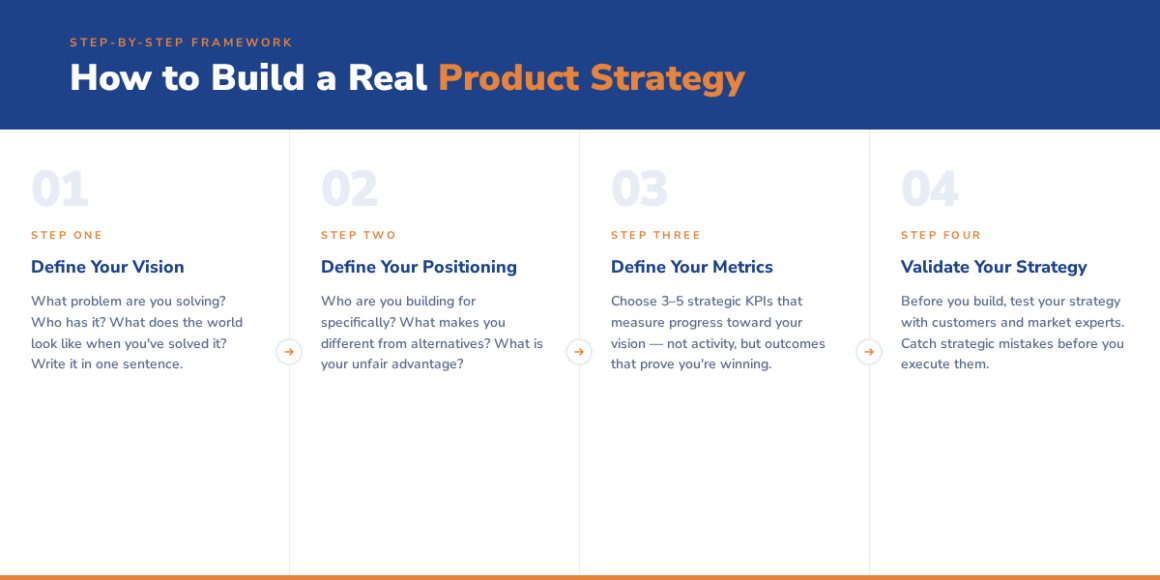
Building a product strategy isn’t complicated, but it requires clarity and discipline. Here is a four-step framework to get started.
Step 1: Define Your Product Strategy Vision
Start with the problem you’re solving. Not the features you’re building. The problem.
Ask yourself: What problem are we solving? Who has this problem? Why does it matter? What will the world look like when we’ve solved it?
Write this down in one sentence. If you can’t do it in one sentence, it’s not clear enough.
Example: “We’re making it possible for distributed teams to collaborate as effectively as co-located teams.”
Step 2: Define Your Positioning
Now, given that vision, what makes you different?
Ask yourself: Who are we building for specifically? What makes us different from alternatives? Why are we uniquely positioned to solve this problem? What’s our unfair advantage?
Your positioning should be specific enough that it shapes your roadmap. If your positioning is “we’re for remote teams,” that shapes different product decisions than “we’re for enterprise companies.”
Step 3: Define Your Strategic Metrics
What would prove you’re moving toward your vision?
Don’t just measure activity. Measure outcomes.
Choose 3–5 strategic metrics maximum. More than that and you lose focus. Productboard’s guide to product metrics recommends pairing one leading indicator (predicts success) with one lagging indicator (confirms success) for each strategic goal — a simple but powerful discipline.
Step 4: Validate Your Product Strategy
Before you build, validate your strategy with customers, prospects, and market experts.
Does your vision resonate? Does your positioning differentiate you? Are your metrics the right ones?
This is where you catch strategic mistakes before you waste resources executing them.
Real-World Example: How Product Strategy Made Slack Win
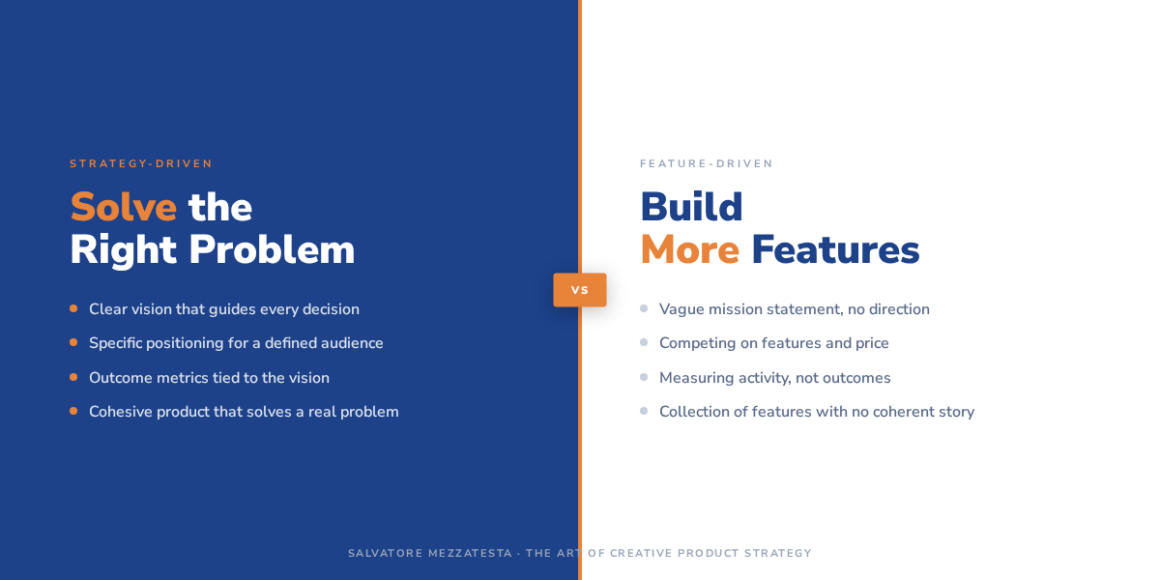
Let me illustrate the power of product strategy with a real example.
Traditional chat tools (like older enterprise messaging platforms):
- Product strategy: Build a feature-rich communication platform
- Positioning: We have more features than competitors
- Metrics: Number of features, user count, uptime
Slack’s product strategy:
- Strategy: Make work less of a mess by replacing email and scattered tools
- Positioning: The collaborative hub for distributed teams
- Metrics: % of teams using Slack as primary communication tool, daily active users, retention
Notice the difference? Slack’s product strategy isn’t “build more features.” It’s “solve a specific problem for a specific audience in a way competitors haven’t thought of.” That strategy shaped everything: the product (real-time search, integrations, channels), the positioning (not a chat tool, but a work hub), the pricing (per user, not per feature), and the go-to-market (bottoms-up adoption, not top-down sales).
Traditional chat tools competed on features. Slack competed on product strategy. The result speaks for itself.
This is exactly the kind of strategic thinking I explore in depth in The Art of Creative Product Strategy — how to move from building features to building direction.
| Aspect | Product Strategy | Product Management |
|---|---|---|
| Focus | The what and why (big picture) | The how (execution) |
| Timeframe | 12–24 months | 1–3 months |
| Key Activities | Market analysis, competitive positioning, vision development | Roadmap execution, feature development, team coordination |
| Output | Strategy document, positioning statement, strategic KPIs | Product roadmap, sprint plans, feature specs |
| Owner | CPO / Head of Product | Product Manager |
Both are essential. Product strategy without execution is just theory. Execution without product strategy is just activity. The best product leaders do both — and if you’re thinking about developing your strategic capabilities, building a strategic mindset as a product manager is a journey worth starting deliberately.
Key Takeaways
- Product strategy is not a feature list. It’s a set of choices that make all other choices easier.
- A real product strategy answers three questions: Where are we going? Why there? How will we know we’ve arrived?
- Most companies get product strategy wrong by confusing it with roadmaps, having vague vision, or measuring the wrong metrics.
- A clear product strategy aligns your team, guides prioritisation, and differentiates you in the market.
- Product strategy without execution is theory. Execution without product strategy is activity. You need both.
Ready to Go Deeper?
Understanding what product strategy is — and isn’t — is the foundation. But knowing the definition isn’t enough. You need to actually build one.
In The Art of Creative Product Strategy, I walk through the complete framework for developing a product strategy that works: how to identify the right problem to solve, how to develop a vision that inspires your team, how to position your product for competitive advantage, and how to define metrics that actually measure progress.
Download Module 1 free — the first module of the book, covering the fundamentals of product strategy, including frameworks, worksheets, and a hands-on workshop you can run with your team. No credit card required.
Frequently Asked Questions About Product Strategy
Q1: What’s the difference between product strategy and product management?
Product strategy is the “what and why” — your long-term vision, positioning, and goals. Product management is the “how” — the day-to-day execution, roadmap development, and team coordination. Product strategy guides management; management executes strategy. A product manager focuses on execution. A product strategist focuses on direction. The best product leaders do both.
Q2: How often should we update our product strategy?
A good product strategy remains stable for 12–24 months, but should be reviewed quarterly for market changes. If you’re updating your strategy every quarter, it’s not strategic — it’s reactive. Update when market conditions fundamentally shift or you’ve learned something that invalidates your assumptions. The key is balance: stable enough to guide decisions, flexible enough to adapt to reality.
Q3: Can a startup have a product strategy, or is it only for big companies?
Startups need product strategy more than big companies. With limited resources, every decision must align with a clear strategic direction. Many startup failures happen because founders skip strategy and jump straight to execution. Start with a clear vision and positioning, even if it’s simple. A one-page product strategy is better than no strategy.
Q4: What happens if we don’t have a product strategy?
Without product strategy, your team becomes reactive. You’ll chase every trend, respond to every customer request, and build features that don’t cohere. You’ll waste resources, confuse your market positioning, and struggle to differentiate. Product strategy is what turns a collection of features into a cohesive product.
Q5: How do we know if our product strategy is working?
Define strategic KPIs before you launch, not after. These should measure progress toward your vision, not just vanity metrics like user count. Examples: retention rate, revenue per user, market share in target segment, customer satisfaction in key areas. After 6–12 months, if you’re hitting your strategic metrics and differentiating in the market, your product strategy is working.
Q6: Should product strategy be written down?
Yes, absolutely. A product strategy that lives only in the founder’s head isn’t a strategy — it’s a secret. Write it down, share it, and revisit it regularly. A one-page strategy document is better than a 50-page deck that no one reads. Written product strategy forces clarity and makes it easier to align your team.
Q7: Who should own the product strategy?
The product leader (CPO or head of product) owns product strategy development, but it must be co-created with leadership (CEO, design, engineering). Strategy without buy-in from execution teams will fail. The best strategies are collaborative. The product leader facilitates the conversation and makes final calls based on market insight and customer understanding.
Q8: Can we have multiple product strategies?
You can have one overarching product strategy with different execution strategies for different markets or segments. But multiple conflicting strategies will tear your organisation apart. Clarity is more important than nuance. One clear product strategy is better than three conflicting ones.
Q9: How do we communicate product strategy to the whole organisation?
Start with a one-page summary (vision, positioning, metrics). Then create department-specific playbooks showing how each team executes the strategy. Repeat the message consistently — people need to hear it seven or more times before it sticks. Use all-hands meetings, team meetings, one-on-ones, and written communication to keep product strategy visible and front of mind.
Q10: What’s the relationship between product strategy and company strategy?
Product strategy should be aligned with company strategy, but they’re not the same. Company strategy is broader (market, business model, revenue). Product strategy is how the product achieves company goals. If they’re misaligned, you’ll have conflict. The best companies have tight alignment: the product strategy supports the company strategy, and the company strategy enables the product strategy.