The Strategy Was Sound. The Team Wasn’t.
There is a particular kind of strategy failure that is especially frustrating because it is invisible until it is too late. The strategy is well-conceived. The vision is clear. The roadmap is logical. And yet, six months in, the product is not moving. Decisions are slow. Priorities are contested. Engineers are building things that designers did not design and product managers did not prioritise. Everyone is working hard. Nothing is working together.
This is product team misalignment, and it is far more common than most product leaders acknowledge. In a 2023 survey by Productboard, 64% of product professionals reported that misalignment between product, engineering, and business stakeholders was their single biggest obstacle to executing strategy effectively. The problem is not that teams lack talent or effort. The problem is that they lack the shared context, decision-making clarity, and leadership structure that makes collective execution possible.
Understanding what product strategy actually means is the starting point, but strategy alone does not create alignment. Alignment is an organisational capability that must be built deliberately, and it is the product leader’s primary responsibility to build it.
This article diagnoses the five root causes of product team misalignment, provides a practical framework for restoring it, and shows how the best product leaders create the shared context that makes strategy executable, without micromanaging the people who execute it.
5 Root Causes of Product Team Misalignment
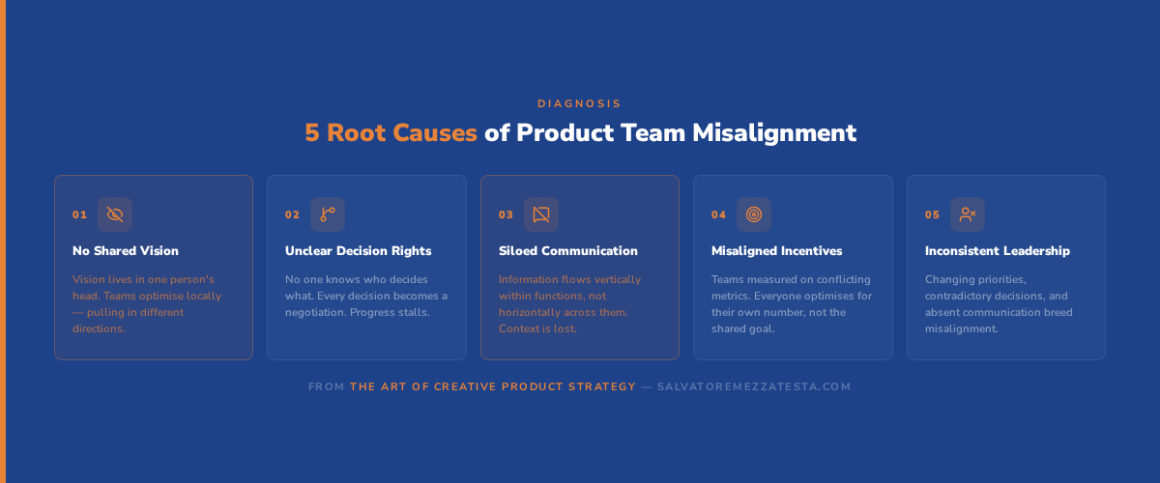
Root Cause 1: No Shared Vision — or a Vision That Lives in One Person’s Head
The most common cause of misalignment is also the most fundamental: the team does not share a common understanding of where the product is going and why. This is not always because the vision is absent. More often it exists, but it lives in the product leader’s head, or in a strategy document that was shared once and never revisited.
A vision that is not actively communicated is not a shared vision, it’s a private one. And a team operating without a shared vision will, by default, optimise for local goals, the engineering team will optimise for technical quality, the design team for user experience, the commercial team for short-term revenue, and those local optimisations will pull in different directions.
The research on this is clear. Google’s Project Aristotle, which studied hundreds of teams to identify the factors that made them effective, found that psychological safety and clarity of purpose were the two strongest predictors of team performance. Purpose clarity, the degree to which team members understood the team’s goals and their contribution to them, was not a nice-to-have. It was a structural requirement for effective collaboration.
The fix: Communicate the vision relentlessly and repeatedly. Research on organisational communication consistently shows that people need to hear a message seven or more times before it becomes part of their working mental model. A vision shared in a single all-hands presentation has not been communicated, it has only been announced. Build vision communication into your regular cadences: sprint reviews, quarterly planning, one-on-ones. Make it impossible for anyone on the team not to know where you are going.
Root Cause 2: Unclear Decision Rights
Misalignment is often not a disagreement about direction, it is a disagreement about who gets to decide. When decision rights are unclear, every significant decision becomes a negotiation. Teams spend time and energy on process rather than progress. The loudest voice wins, or the most senior person wins, or the decision gets escalated to leadership — where it sits in a queue until urgency forces a suboptimal choice.
The RACI framework (Responsible, Accountable, Consulted, Informed) is the standard tool for clarifying decision rights, but most product teams apply it to projects rather than to the types of decisions they make repeatedly. The more useful application is to define decision rights by decision type: who owns product direction decisions, who owns technical architecture decisions, who owns commercial prioritisation decisions, and what the escalation path is when those decisions conflict.
Amazon’s “two-pizza team” model is instructive here. The principle is not just about team size, but about decision autonomy. Small, autonomous teams with clear ownership of a domain can make decisions quickly because they do not need to coordinate with everyone else before acting. The product leader’s job is to define the boundaries of that autonomy clearly enough that teams can exercise it confidently.
The fix: Map your most common decision types and assign clear ownership. For each type, define who decides, who is consulted, and who is informed. Publish this map and refer to it when conflicts arise. The goal is not to eliminate disagreement, but to ensure that disagreement resolves into a decision rather than into paralysis.
Root Cause 3: Siloed Communication
In most product organisations, information flows vertically, up and down within functions, far more efficiently than it flows horizontally across them. Engineers know what engineers are building. Designers know what designers are designing. Product managers know what is on the roadmap. But the degree to which these three groups share a common understanding of the whole is often surprisingly low.
This is not a failure of individual communication, but a structural failure. When teams are organised by function and measured by functional outcomes, horizontal communication is not incentivised. It requires deliberate effort to overcome the gravitational pull of functional silos.
The most effective product teams address this through structured cross-functional rituals: weekly syncs that bring engineering, design, and product together around shared goals rather than functional updates; shared documentation that makes decisions and their rationale visible to everyone; and explicit “translation” practices that help each function understand the constraints and priorities of the others.
Teresa Torres’s continuous discovery framework, which advocates for weekly touchpoints between product, design, and engineering around customer insights, is one of the most practical models for building horizontal communication into the team’s operating rhythm. The principle is simple: the more frequently cross-functional teams share what they are learning, the less likely they are to build things that conflict.
The fix: Audit your communication structure. How often do product, engineering, and design share context in the same room? If the answer is “at sprint planning and nowhere else,” you have a silo problem. Build at least one weekly cross-functional ritual that is explicitly about shared understanding, not status updates.
Root Cause 4: Misaligned Incentives
Teams align around what they are measured on. If the product team is measured on features shipped, the engineering team on velocity, the design team on design quality scores, and the commercial team on quarterly revenue, you have not built a product organisation but four separate organisations that happen to work on the same product.
Incentive misalignment is particularly insidious because it is invisible in day-to-day interactions. Everyone appears to be working toward the same goal. But when a decision requires one team to sacrifice their metric for the benefit of another team’s metric, when slowing down velocity would improve quality, or when delaying a feature would improve the user experience, then the incentive structure determines the outcome, not the strategy.
The solution is not to eliminate functional metrics, because they serve a purpose. It is to layer shared outcome metrics on top of them: metrics that the entire product organisation is jointly accountable for, and that reflect the strategic goals of the product rather than the operational goals of individual functions. OKRs (Objectives and Key Results) are the most widely used framework for this, precisely because they create a shared language of outcomes that cuts across functional boundaries.
The fix: Define two to three shared outcome metrics that the entire product organisation is accountable for — metrics that reflect what strategic success actually looks like for your product. Make these metrics visible to everyone, review them in every cross-functional meeting, and ensure that individual functional metrics are explicitly connected to them.
Root Cause 5: Absent or Inconsistent Leadership
The final root cause is the one that is hardest to acknowledge, because it implicates the leader directly. Misalignment does not sustain itself, but it’s either created or allowed by leadership behaviour. A product leader who changes priorities frequently, communicates inconsistently, makes decisions that contradict stated strategy, or fails to model the collaborative behaviour they expect from the team will produce a misaligned team regardless of how good the strategy document is.
Leadership consistency is not about being inflexible. It is about being predictable in the things that matter: the vision, the values, the decision-making process, and the standards of behaviour. When team members cannot predict how the leader will respond to a given situation, they default to self-protection and optimise for what they think the leader wants rather than what the strategy requires.
Amy Edmondson’s research on psychological safety at Harvard Business School demonstrates that the single most important factor in creating psychologically safe teams, teams where people are willing to take risks, raise concerns, and challenge assumptions, is leader behaviour. Specifically, leaders who model curiosity, acknowledge their own uncertainty, and respond to mistakes with learning rather than blame create the conditions for the honest communication that alignment requires.
The fix: Audit your own leadership behaviour before diagnosing the team. Are you communicating the vision consistently? Are your decisions aligned with the strategy you have stated? Are you creating the psychological safety that honest cross-functional communication requires? Alignment starts with the leader, not with the team.
The Alignment Framework: Three Practices That Work
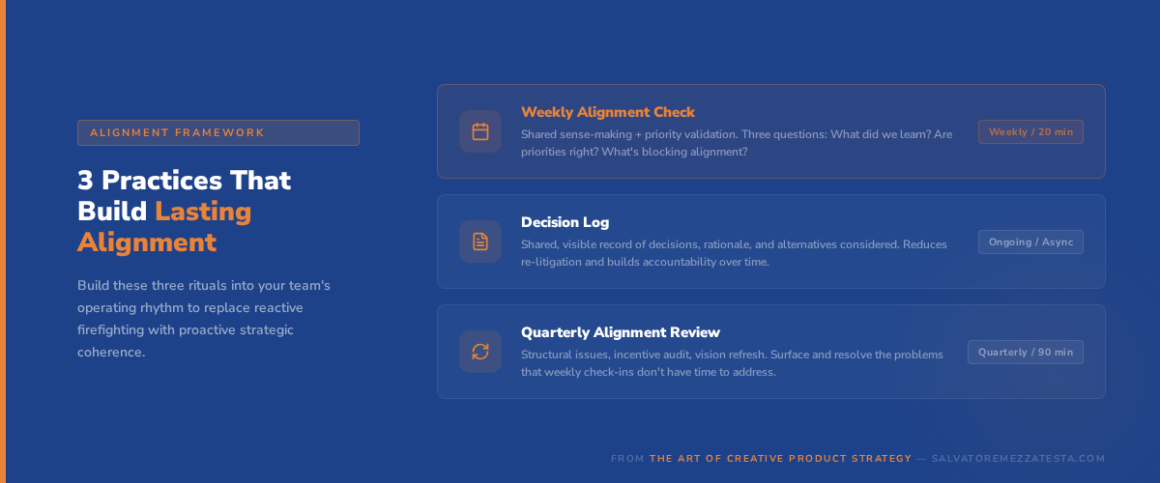
Diagnosing misalignment is the first step. Fixing it requires building three practices into the team’s operating rhythm.
Practice 1: The Weekly Alignment Check
A short, structured weekly ritual — fifteen to twenty minutes — in which the cross-functional team reviews three questions:
- What did we learn this week that is relevant to our strategy?
- Are our current priorities still the right ones?
- Is there anything blocking alignment that needs to be resolved?
This is not a status update meeting. It is a shared sense-making ritual that keeps the team’s understanding of the situation current and consistent.
Practice 2: The Decision Log
A shared, visible record of significant decisions — what was decided, who decided it, what the rationale was, and what alternatives were considered. The decision log serves two purposes: it reduces the number of decisions that need to be relitigated (because the rationale is documented), and it creates accountability for decision quality over time. Notion and Confluence are the most commonly used tools for this in product teams.
Practice 3: The Quarterly Alignment Review
A deeper, quarterly review that asks: Is our product vision still shared across the team? Are our incentive structures aligned with our strategic goals? Are there communication patterns that are creating silos? This is the moment to surface and resolve the structural issues that the weekly check does not have time to address.
| Practice | Frequency | Purpose | Duration |
|---|---|---|---|
| Weekly Alignment Check | Weekly | Shared sense-making, priority validation | 15–20 min |
| Decision Log | Ongoing | Decision accountability, reduced re-litigation | Async |
| Quarterly Alignment Review | Quarterly | Structural issues, incentive audit, vision refresh | 90–120 min |
Case Study: How Spotify Builds Alignment at Scale
Spotify’s squad model is one of the most studied examples of cross-functional team alignment in the product industry. The model, in which small, autonomous squads own end-to-end responsibility for a specific area of the product, is often cited for its structural innovation. But the alignment mechanism that makes it work is less often discussed.
Each squad at Spotify operates with a clear mission (a statement of the problem they exist to solve), a set of shared metrics (the outcomes they are accountable for), and a defined relationship to the broader product strategy. The mission is not set by the squad but is set by product leadership, in alignment with the company’s overall strategic direction. The squad’s autonomy is in how they pursue the mission, not in what the mission is.
This distinction is critical. Alignment does not require uniformity of method but clarity of purpose. Squads can work in different ways, use different tools, and make different technical decisions, as long as they are all moving toward the same strategic destination. The product leader’s job is to make that destination clear, keep it stable, and ensure that the metrics each squad is accountable for are genuinely connected to it.
As Spotify’s former VP of Product described in an interview with Reforge, the hardest part of scaling the squad model was not the structure but maintaining strategic coherence as the number of squads grew. The solution was not more process. It was better strategic thinking at the leadership level: clearer vision, more consistent communication, and a more disciplined approach to connecting squad missions to company strategy.
Key Takeaways
- Misalignment is structural, not personal. The root causes of product team misalignment are systemic: unclear vision, ambiguous decision rights, siloed communication, misaligned incentives, and inconsistent leadership. Fixing them requires structural interventions, not individual blame.
- Vision must be communicated relentlessly. A vision shared once is not a shared vision. Build vision communication into every regular cadence: sprint reviews, quarterly planning, one-on-ones, until it becomes part of the team’s working mental model.
- Decision rights must be explicit. Map your most common decision types and assign clear ownership. The goal is not to eliminate disagreement but to ensure that disagreement resolves into a decision rather than into paralysis.
- Shared outcome metrics create shared accountability. Layer two to three shared outcome metrics on top of functional metrics. Make them visible to everyone and review them in every cross-functional meeting.
- Alignment starts with the leader. Audit your own behaviour before diagnosing the team. Consistency, psychological safety, and honest communication are leadership responsibilities, not team characteristics.
Ready to Build a Team That Executes Strategy?
The alignment framework in this article is drawn from Module 8 of The Art of Creative Product Strategy, a full chapter on leadership, team dynamics, and the organisational practices that make strategy executable.
If you are serious about building a product organisation that executes with clarity and cohesion, the book gives you the complete framework.
Get The Art of Creative Product Strategy on Amazon →
Want to start with the foundations?
Before alignment, you need clarity. Download Module 1 free and build the strategic foundation that makes team alignment possible. Download Module 1 Free →
Frequently Asked Questions About Product Team Alignment
Q1: What is product team alignment, and why does it matter?
Product team alignment is the degree to which all members of a product organisation — product managers, engineers, designers, and commercial stakeholders — share a common understanding of the product’s direction, priorities, and decision-making process. It matters because misalignment is one of the most common and most expensive causes of strategy failure. Teams that are misaligned waste resources on work that does not contribute to strategic goals, make decisions that conflict with each other, and produce products that are incoherent from the user’s perspective.
Q2: How do I know if my product team is misaligned?
The clearest signs are: decisions that take longer than they should because ownership is unclear; recurring disagreements about priorities that are never fully resolved; engineering, design, and product working from different assumptions about what the product is trying to achieve; and a gap between what the strategy says and what the team is actually building. If you ask five people on your team “what is the most important thing we are trying to achieve this quarter?” and get five different answers, you have an alignment problem.
Q3: Is misalignment always the leader’s fault?
Not always, but the leader is always responsible for addressing it. Misalignment can be caused by organisational structure, incentive design, communication tools, or historical decisions that predate the current leader. But regardless of cause, the leader is the person with the authority and responsibility to diagnose and fix it. Blaming the team for misalignment that the leader has not addressed is not leadership.
Q4: How long does it take to fix product team misalignment?
It depends on the root cause and the severity. Misalignment caused by unclear vision can often be addressed within weeks through consistent communication. Misalignment caused by structural incentive problems may take a full planning cycle to fix. Misalignment caused by deep cultural issues — lack of psychological safety, entrenched silos, historical mistrust — may take six to twelve months of sustained effort. The key is to start with the most impactful root cause and work systematically.
Q5: Can you have too much alignment?
Yes. Over-alignment — where teams are so tightly coordinated that they cannot act autonomously — is as damaging as misalignment. The goal is not uniformity; it is shared direction with distributed execution. Teams should agree on where they are going and why, but have genuine autonomy in how they get there. Leaders who micromanage in the name of alignment are actually creating a different kind of misalignment — one where the team’s capacity for independent judgment atrophies.
Q6: How do OKRs help with product team alignment?
OKRs (Objectives and Key Results) create a shared language of outcomes that cuts across functional boundaries. By defining objectives at the team or company level — rather than at the functional level — OKRs make it explicit that engineering, design, and product are working toward the same goals. The key results provide measurable evidence of progress that everyone can see and discuss. When OKRs are set well, they replace the question “what should we prioritise?” with “what moves our key results?” — which is a much more productive conversation.
Q7: What is the difference between alignment and consensus?
Alignment means everyone understands and is committed to the direction, even if they did not all agree with the decision that set it. Consensus means everyone agreed. Alignment is achievable and necessary; consensus is often neither. The best product leaders make decisions clearly, explain the rationale honestly, and create the psychological safety for people to disagree — while also committing to the decision once it is made. Confusing alignment with consensus leads to either slow decision-making (waiting for everyone to agree) or false alignment (people nodding while privately disagreeing).
Q8: How do you maintain alignment as the team scales?
Alignment becomes harder to maintain as teams grow because the number of communication paths increases exponentially with team size. The solution is not more meetings, but better structure. As teams scale, invest in: clearer documentation of decisions and their rationale; more explicit definition of team missions and decision rights; and regular cross-functional rituals that keep shared context current. The Spotify squad model is one example of how to maintain strategic coherence at scale through structural clarity rather than through centralised control.
Q9: How do you align stakeholders outside the product team?
External stakeholders — sales, marketing, customer success, finance — are often the most challenging alignment problem because they have different incentives and different time horizons than the product team. The most effective approach is to involve them in the strategy process early, share the strategic rationale for product decisions proactively, and create regular touchpoints where they can raise concerns before they become conflicts. Alignment with external stakeholders is not about getting them to agree with every product decision — it is about ensuring they understand the strategic logic behind those decisions.
Q10: What is the role of psychological safety in team alignment?
Psychological safety — the belief that one can speak up, raise concerns, and challenge assumptions without fear of punishment — is a prerequisite for genuine alignment. Teams that lack psychological safety produce false alignment: people appear to agree in meetings but act on different assumptions when the leader is not watching. Real alignment requires honest communication, and honest communication requires safety. Leaders who want aligned teams must first create the conditions in which honest disagreement is possible.